
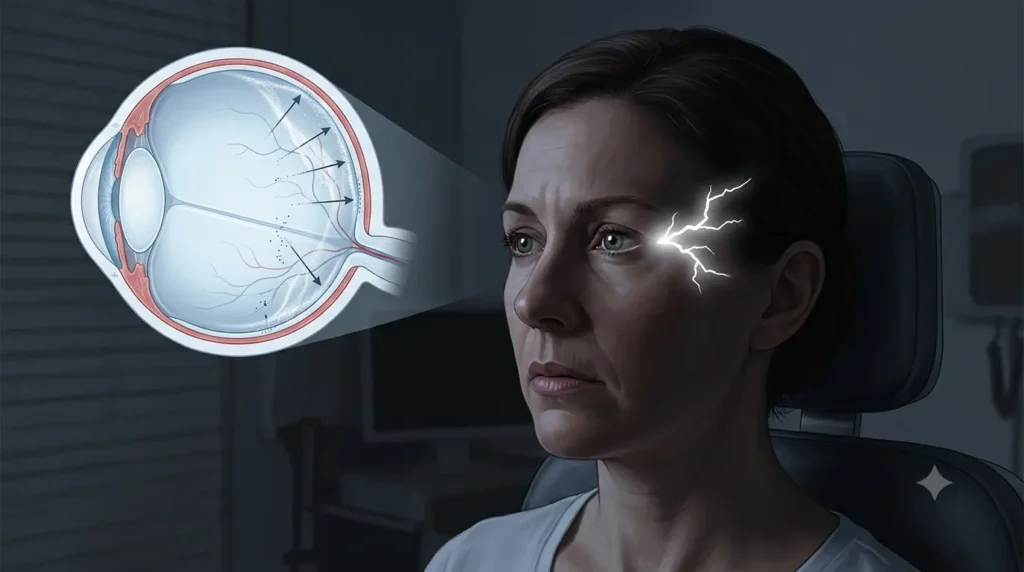
I was sitting in a dark room once when a streak of light shot across the edge of my vision. No lamp. No headlights. Nothing outside that could’ve caused it. Gone in a blink, but it rattled me for the rest of the night.
If that sounds like you, welcome to a very common club. Seeing flashes of light in eyes is one of those symptoms that sends people down a late-night search spiral, phone in hand, heart rate climbing. Almost everyone typing “flashes of light in eyes” into Google is trying to answer one thing: is this normal, or is this the start of something worse?
Most people land here for one of two reasons. Either they noticed eye flashes once and got curious, or the flashing lights in vision keep coming back and they’re genuinely scared. Some people are specifically seeing flashes in one eye, others notice flashing lights in peripheral vision on both sides, and the difference actually matters. Both reactions make sense. Here’s the short version: occasional flashes are usually tied to normal changes happening inside your eye as you age. But sometimes, they’re your body’s way of waving a red flag.
Table of Contents
What Is Seeing Flashes of Light in Eyes?
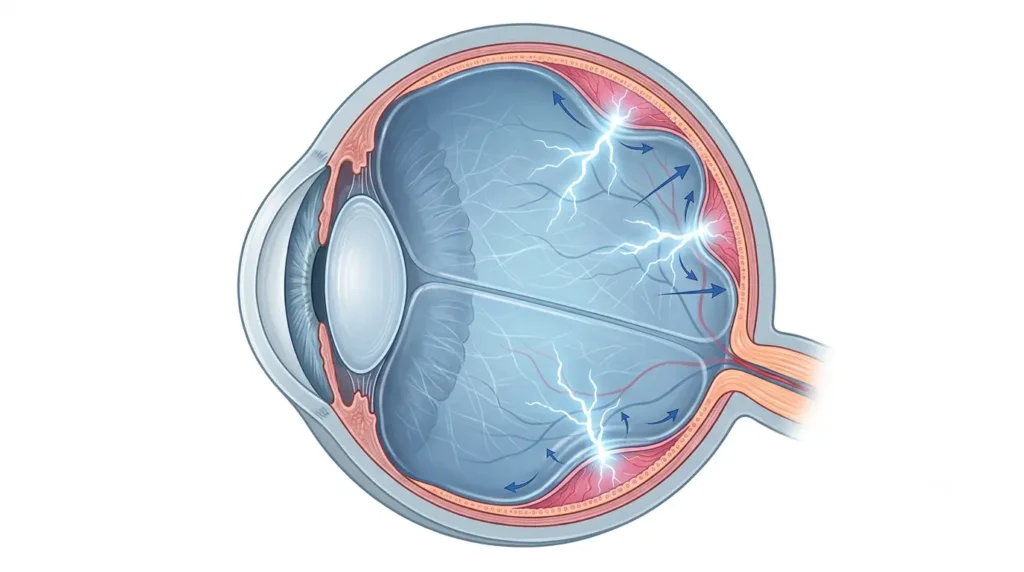
The medical term is photopsia. Fancy word, simple idea: brief bursts, streaks, or sparks of light appearing in your vision with zero actual light causing them.
People describe eye flashes in all kinds of ways:
- Lightning streaks or jagged zigzag lines
- Sparkles or shimmering spots
- Quick camera-flash-style bursts
- Brief flickers off to the side, in peripheral vision
- Bright spots that appear then vanish almost instantly
Here’s the part that surprises most people. These flashes start inside your eye. Not from your environment. That’s why they show up even with your eyes shut, or in a completely dark room — less visual clutter means you actually notice the flashing lights more.
So why does this happen? Your retina sits at the back of your eye, and it’s built to respond to real light. But it’s not picky about how it gets triggered. If something tugs it, presses it, or pulls it, the retina fires off a signal anyway, and your brain reads that signal as light. Rub your eyes hard enough and you’ll see this exact effect firsthand.It’s important not to confuse these flashes with eye strain. While prolonged screen use can cause tired, dry, or aching eyes, true flashes of light usually point to a different process inside the eye.
Most of your eye’s interior is filled with a clear gel called the vitreous. As you get older, that gel thins out and shrinks a bit. Sometimes it pulls on the retina as it separates away. That tug is the single most common reason people start seeing flashes of light in eyes, and it explains the vast majority of cases doctors see under this umbrella.
What Causes Seeing Flashes of Light in Eyes?
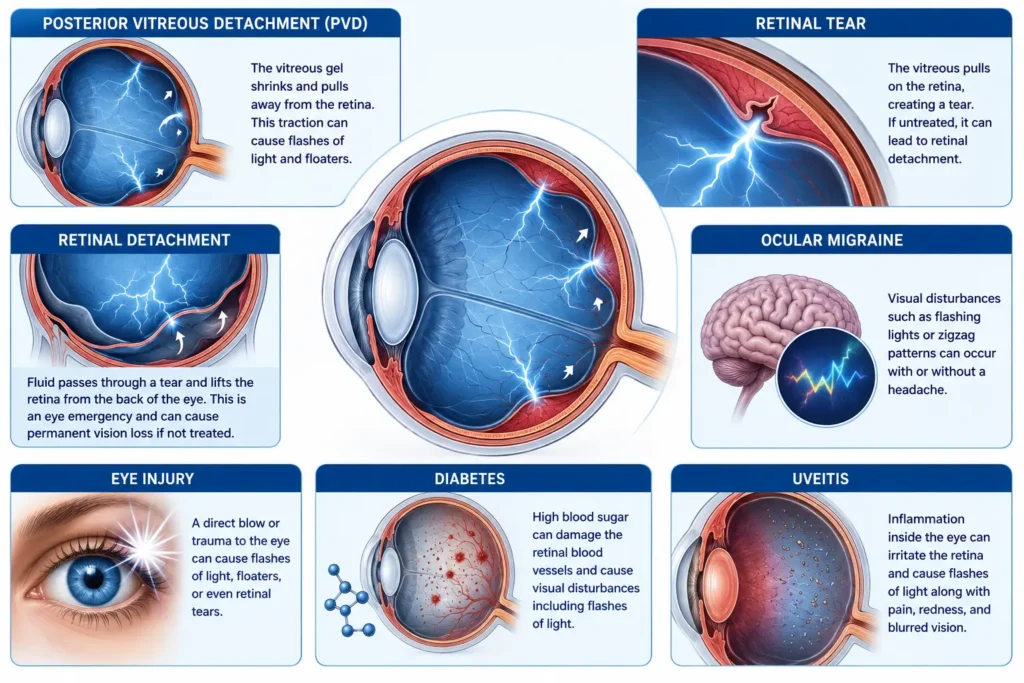
Posterior Vitreous Detachment (PVD)
I already touched on this above, but it deserves its own spotlight because it’s the leading cause by a wide margin. As the vitreous gel shrinks with age, it separates from the retina. That separation is called posterior vitreous detachment, or PVD.
PVD is incredibly common. By age 65, roughly three out of four people will have gone through it, and prevalence keeps climbing after that — closer to a quarter of people in their 50s, and up around 87% by the 80s. Most of the time, it’s uneventful. Flashes and floaters show up, then gradually fade over a few weeks to a few months as the vitreous finishes detaching.
Retinal Tear
Sometimes, instead of separating cleanly, the shrinking vitreous pulls hard enough to tear the retina itself. This is where things get more serious. Clinical guidelines from the American Academy of Ophthalmology note that somewhere between roughly 8% and 22% of patients who show up with sudden, symptomatic PVD already have a retinal tear at that very first exam. That’s not a small number, and it’s exactly why doctors take new flashes seriously instead of brushing them off.
A retinal tear on its own doesn’t always cause vision loss, but it’s a direct pathway toward retinal detachment if it’s left alone.
Retinal Detachment
This is the most serious cause because delayed treatment can permanently affect vision. A retinal detachment happens when fluid slips through a tear and lifts the retina away from the back wall of the eye. Once that happens, the retina can’t do its job properly, and permanent vision loss becomes a real risk if it’s not treated fast.
Research on patients referred from community eye clinics found that an untreated new retinal tear progresses to full detachment in roughly 30% to 47% of cases. Prompt treatment brings that risk down to somewhere between 2% and 9%. That gap is the entire reason urgency matters here.
Ocular Migraine
Not every flash points to your eye at all. Sometimes the trigger sits in your brain. This is called an ocular migraine, or migraine aura, and it can happen with a headache, or completely without one. The pattern usually looks different too — a slowly expanding, shimmering zigzag line rather than a quick streak, often lasting 20 to 60 minutes.
Eye Injury
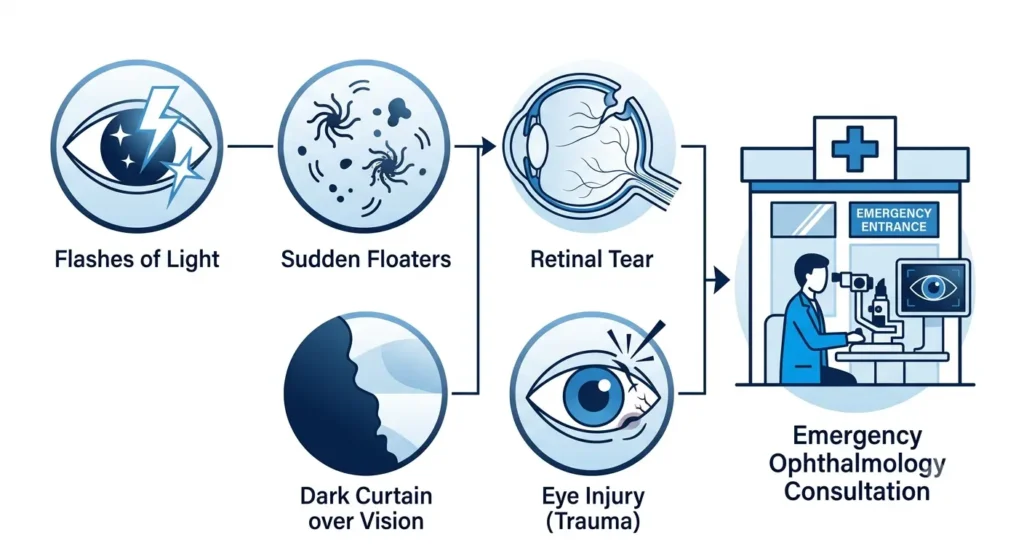
A direct hit to the eye or head can jolt the vitreous or bruise the retina, and flashes showing up right after trauma are extremely common. Even a fairly minor knock deserves a same-day or next-day exam, because trauma-related tears aren’t rare.
Diabetes
Diabetes damages small blood vessels throughout the body, and the retina isn’t spared. Diabetic retinopathy can eventually trigger visual disturbances, flashes included, especially as blood sugar control slips over time. If you’re diabetic and you’re newly seeing flashes, mention your diagnosis to your eye doctor right away If you have diabetes, let your eye doctor know because it helps guide the examination and overall assessment.
Uveitis
Uveitis is inflammation inside the eye, and it can irritate the retina enough to produce flashes as one of several symptoms, alongside redness, pain, and blurred vision. It’s less common than PVD as a cause, but it’s one your doctor will screen for if your eye also looks red or feels sore.
Rare Neurological Causes
Occasionally, flashes trace back to something happening in the brain rather than the eye — a transient ischemic attack (a mini-stroke), a seizure affecting the visual cortex, or rarely, a tumor pressing on visual pathways. These are uncommon. But if flashes show up alongside slurred speech, sudden weakness, confusion, or a severe headache unlike any you’ve had before, that’s an emergency, full stop.
Symptoms That May Occur Alongside Eye Flashes
Flashes rarely travel completely alone. Paying attention to what else is going on tells you a lot about how urgent your seeing flashes of light in eyes situation actually is. Common companions include:
- Floaters — specks, threads, or cobweb shapes drifting through your vision
- Blurry vision, especially if it’s new or getting worse
- A curtain or shadow creeping over part of your visual field
- Loss of peripheral vision
- Eye pain or a feeling of pressure. If your symptoms involve swelling around the eye rather than flashes inside your vision, read our guide on swollen eyelid to understand the most common causes.
- Headache, particularly one that follows the visual symptom
- Zigzag lines or shimmering patterns
- Double vision
A flash by itself is often nothing dramatic. Flashes stacked with two or three of these other symptoms are what push a “wait and see” situation into a “call today” situation.
Flashes vs. Floaters vs. Migraine Aura
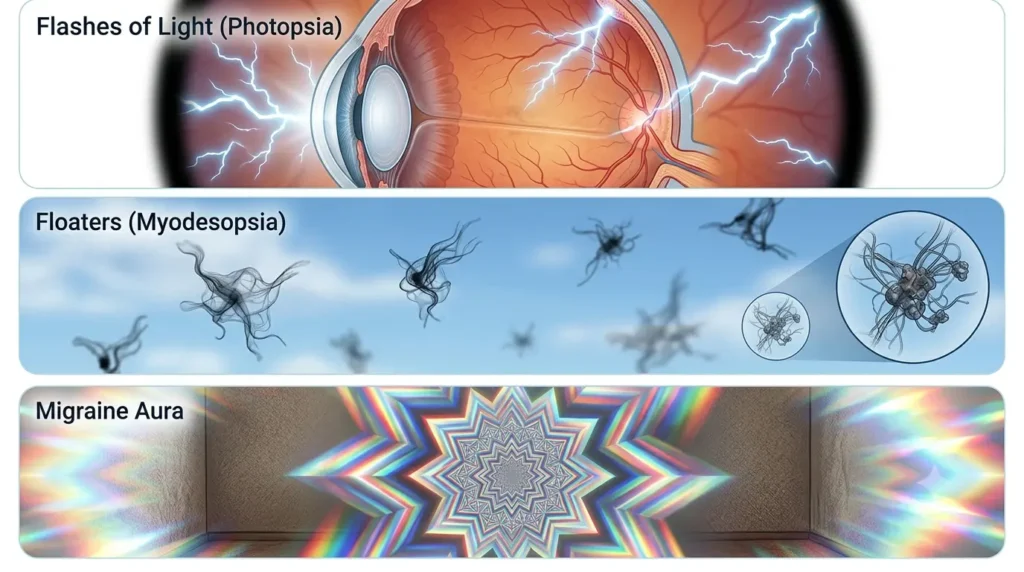
These three symptoms get mixed up constantly, so let me lay them out side by side.
| Symptom | What It Looks Like | How Long It Lasts | Root Cause |
|---|---|---|---|
| Flashes of light | Quick streaks, sparks, bursts | Seconds — comes and goes | Vitreous tugging on retina |
| Floaters | Dark specks, threads, cobweb shapes drifting around | Sticks around, may fade slowly | Debris clumped inside the vitreous |
| Migraine aura (ocular migraine) | Shimmering zigzag lines, wavy heat-like distortion | 20 to 60 minutes | Temporary brain activity shift, not eye-based |
| Halos or starbursts | Rings or glare circling lights | Constant, worse at night | Often cataracts or post-surgery changes |
Knowing which bucket your symptom fits gives you a real advantage when talking to a doctor. Vague descriptions slow diagnosis down. Precise ones speed it up.
How Doctors Diagnose Eye Flashes
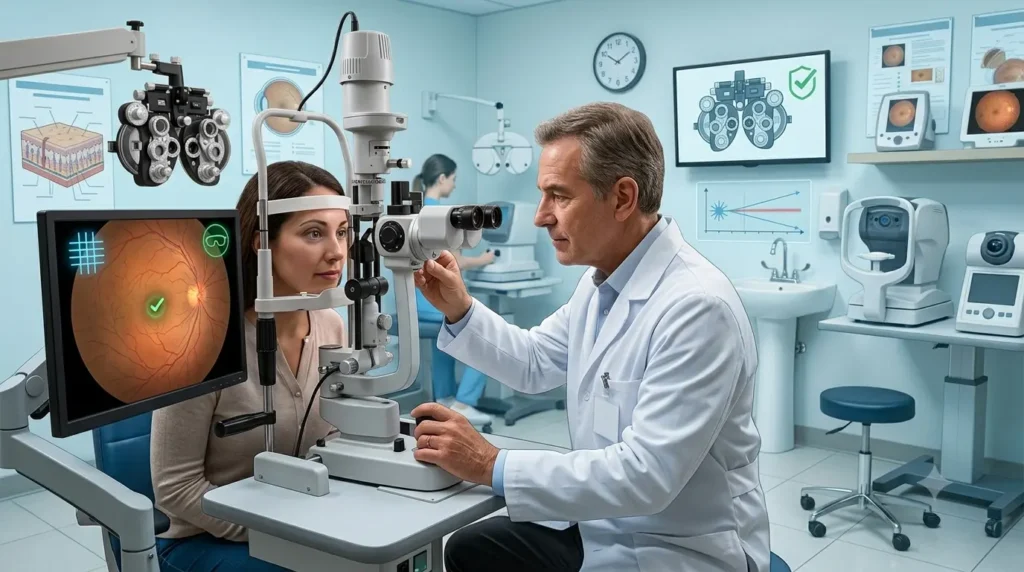
You can’t diagnose the cause of seeing flashes of light in eyes by symptoms alone — I want to be honest about that. A proper exam is the only way to know for sure. Here’s what that usually involves:
- Dilated eye examination. Drops widen your pupil so the doctor can see your entire retina, including the far edges where tears most often hide.
- Retinal examination. Using specialized lenses, the doctor checks the retina directly for tears, detachment, or areas of thinning.
- Slit-lamp exam. A focused light and microscope let the doctor look closely at the front and middle structures of your eye, checking for signs like pigment cells that hint at a retinal problem.
- Optical coherence tomography (OCT). This scan creates a cross-sectional image of your retina, useful for spotting subtle traction or swelling that’s hard to catch with the eye alone.
- Ocular ultrasound. If bleeding inside the eye is blocking a clear view of the retina, ultrasound helps the doctor see behind that blood.
None of these tests are painful, and most take just a few minutes each. A full workup usually wraps up in one visit.
Is Seeing Flashes of Light in Eyes Actually Serious?
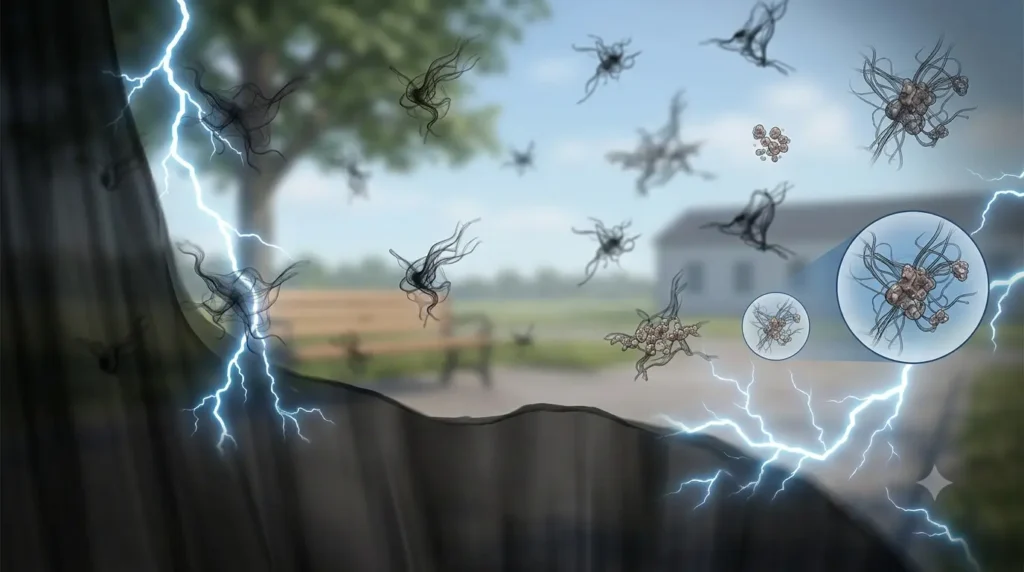
This is the real question underneath everything else. Whether seeing flashes of light in eyes is serious depends entirely on the pattern, not on the flash itself.
Usually lower concern:
- Occasional, brief flashes of light in eyes that have shown up on and off for a while without escalating
- Flashes you can trace to something specific — rubbing your eyes, standing up too fast
- No floaters, no vision loss, no shadowing alongside the flashes
Usually higher concern:
- Flashes that started suddenly and never happened before
- A clear increase in how often you’re seeing them
- New floaters, blurry patches, or a dark curtain creeping into your vision
- Flashes that started right after a hit to the eye or head
The American Society of Retina Specialists puts this in useful perspective: about 85% of people who go through PVD never develop a complication, and in most cases the flashes and floaters fade within roughly three months. That’s genuinely reassuring. But it also means around 1 in 7 people do run into a complication, which is exactly why that first exam matters so much.
Treatment for Seeing Flashes of Light in Eyes
Treatment for seeing flashes of light in eyes isn’t one-size-fits-all. It depends completely on what’s causing the flashes in the first place.
Observation for uncomplicated PVD. If your exam comes back clean, no treatment is needed. Your doctor monitors you, and the flashes typically fade on their own over weeks to months.
Laser treatment for retinal tears. Laser photocoagulation seals the edges of a tear before it can progress to a detachment. It’s done in-office, takes minutes, and is highly effective when caught early. Cryotherapy (a freezing treatment) works similarly and is used depending on the tear’s location.
Vitrectomy in selected cases. For a retinal detachment, or for PVD complications that don’t resolve on their own, a vitrectomy removes the problematic vitreous gel surgically. This is a bigger step, reserved for more advanced situations.
Treating migraine. If ocular migraine is behind your flashes, management focuses on identifying and avoiding triggers, staying hydrated, keeping consistent sleep, and sometimes preventive medication for people with frequent attacks.
Managing diabetes. Tighter blood sugar control slows the progression of diabetic retinopathy and reduces the chance of it contributing to visual disturbances down the line.
Treating inflammation. For uveitis, anti-inflammatory eye drops or oral medication calm the inflammation, which typically resolves the flashes along with the other symptoms.
Can You Prevent Eye Flashes?
You can’t stop the natural aging process behind seeing flashes of light in eyes — that one’s coming for all of us eventually. But you can lower your risk of the complications that actually matter, and catch problems early when they’re most treatable.
- Get regular eye exams, especially past age 50 or if you’re highly nearsighted.
- Wear protective eyewear during sports, yard work, or any activity with a real risk of eye trauma.
- Keep diabetes under control through regular monitoring and following your care plan.
- Manage blood pressure, since chronically high blood pressure can affect the small vessels feeding your retina over time.
- Avoid unnecessary eye trauma — that means actually wearing safety glasses, not just owning a pair.
- Seek evaluation early the moment new flashes show up, rather than waiting to see if they get worse.
None of this guarantees you’ll never see a flash. It just stacks the odds heavily in your favor.
Many cosmetic concerns, such as dark circles under the eyes, affect appearance but are not usually linked to flashes of light or retinal problems.
What To Actually Do When You Notice Flashes of Light in Eyes
Panic doesn’t help here. A clear head does. Here’s exactly how I’d walk through noticing flashes of light in eyes, step by step.
- Stop and observe. One eye or both? Roughly how many flashes so far?
- Scan for other symptoms. Any new floaters? Blurry patches? A shadow creeping in from the side?
- Think about timing. Did this start after an injury, a headache, fast head movement, or completely out of nowhere?
- Write it down. Date, time, quick description. This helps your eye doctor connect the dots fast.
- Judge the urgency. One mild flash with nothing else going on can usually wait for a routine visit. Multiple new flashes with floaters or vision changes need prompt evaluation.
- Book a dilated eye exam. This is the only reliable way anyone can actually see your retina and vitreous directly.
- Follow up like you’re told to. Even a clean bill of health might come with a recommendation to check again in a few weeks, especially past age 50 or with risk factors like diabetes.
Mistakes I See People Make Constantly
- Assuming every instance of flashes of light in eyes is harmless. Often true, but that assumption is exactly what delays care when it’s not.
- Ignoring flashes of light in eyes that show up with floaters. This combo is one of the bigger warning signs out there. Don’t wave it off.
- Mixing up migraine aura with retinal flashes. They come from completely different places in your body and carry different urgency levels.
- Sitting on symptoms after an eye injury. A blow to the face or eye followed by flashes needs prompt evaluation, not a “let’s see how tomorrow goes” approach.
- Forgetting to mention medications. Some drugs are linked to visual disturbances. Leaving that detail out slows your doctor down.
Choosing the Right Care (And Trusting Your Judgment)
Go for a full dilated eye exam, not just a basic vision screening. Dilation is what lets a doctor actually see your retina and vitreous properly — skip it and you’re getting half the picture.
Pick a licensed ophthalmologist or optometrist who’s comfortable evaluating the retina, especially if your flashes are new or getting more frequent. If you’re diagnosed with posterior vitreous detachment, many specialists want a follow-up exam within a few weeks, since a meaningful share of these cases go on to develop a retinal tear afterward.
Not sure if your symptom counts as “serious enough” to call about? Call anyway. Describe exactly what you’re seeing. Most eye clinics can help you judge urgency over the phone in a few minutes, and that phone call costs you nothing.
Frequently Asked Questions
Are flashing lights in eyes serious? Not always. Occasional, brief flashes — especially in older adults — usually connect to normal vitreous changes and aren’t an emergency. A sudden onset, rising frequency, or flashes paired with floaters or vision loss are the warning signs that need prompt attention.
Are flashing lights a symptom of stroke? Yes, in some cases. Visual disturbances, including flashes, can appear during a transient ischemic attack (TIA) or stroke, especially alongside slurred speech, one-sided weakness, or sudden vision loss. If you notice flashing lights with those symptoms, treat it as an emergency and get help immediately.
How do I stop flashes of light in my eye? There’s no guaranteed fix for flashes caused by normal vitreous shrinkage — that’s just aging doing its thing. When an underlying issue like inflammation or a retinal tear is behind it, treating that specific cause is what actually reduces or resolves the flashes. An eye specialist is the only one who can tell you which category you’re in.
Can high blood pressure cause flashing lights in the eyes? It can contribute. High blood pressure affects the blood vessels in your retina over time, and that damage can sometimes show up as visual disturbances, flashes included. It’s one of several conditions — alongside diabetes and migraine — that eye specialists routinely ask about.
Can flashes of light happen without a headache? Yes, and this trips people up constantly. Migraine aura often comes with flashes, sure, but plenty of causes — vitreous changes, retinal traction — have absolutely nothing to do with headaches.
Can stress or dehydration cause flashes of light? Some people notice visual disturbances during intense stress, exhaustion, or dehydration, though these are far less common explanations than vitreous-related causes. If flashes persist or get worse, don’t chalk it up to stress without getting a real eye exam first.
What percentage of PVD cases involve a retinal tear? Clinical guidelines put it at roughly 8% to 22% of patients with acute, symptomatic PVD at their initial exam, which is why doctors examine every new case carefully rather than assuming it’s routine.
A Quick Note on Accuracy
This guide exists to help you understand the common causes and patterns behind seeing flashes of light in eyes, and why seeing flashes of light in eyes sometimes needs urgent care. It’s built on information from sources including the American Academy of Ophthalmology, the American Society of Retina Specialists, and peer-reviewed research indexed through the National Center for Biotechnology Information. It isn’t a substitute for a licensed professional’s evaluation. If you’re experiencing sudden or worsening visual symptoms, book time with a qualified ophthalmologist or optometrist. An article, however thorough, can’t examine your retina. Only a doctor can.
Sources referenced:
- Medical reviewers and trusted sources include the American Academy of Ophthalmology (AAO), the American Society of Retina Specialists (ASRS), and peer-reviewed medical literature.
Where This Leaves You
Seeing flashes of light in eyes is far more common than most people realize, and a lot of the time, it’s just your eyes doing what eyes do as they age. But this symptom sits in a spot where paying attention actually pays off. One mild flash, on its own? Probably nothing to lose sleep over. A sudden wave of flashes of light in eyes, a growing pattern, or flashes showing up next to floaters and vision loss? That’s worth taking seriously and checking soon.
The most useful thing you can do isn’t more googling. It’s booking a proper dilated eye exam. A specialist can look directly at your retina and vitreous and tell you, with far more certainty than any article ever could, whether what you’re seeing is routine or something that needs real attention. If you’re on the fence, ask. That call is always worth making.