
Table of Contents
AI in Eye Care: How Artificial Intelligence Is Changing the Way We Protect Our Vision
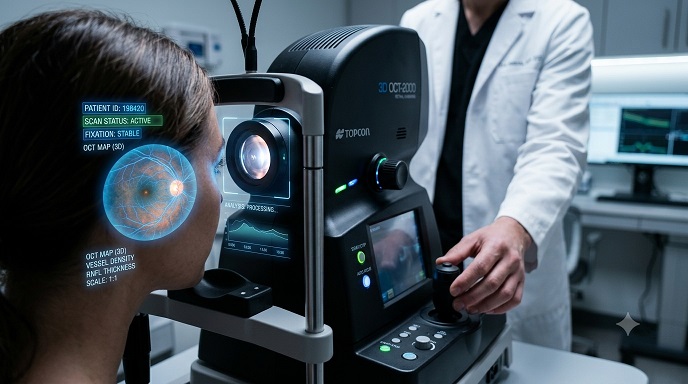
I’ve spent time researching how hospitals and eye clinics actually use technology, and one thing keeps standing out to me: AI in eye care isn’t some far-off idea anymore. It’s already sitting quietly behind the scenes at your local optometrist’s office, scanning images, flagging problems, and helping doctors catch diseases before they steal someone’s sight.
Here’s why that matters. Diseases like diabetic retinopathy, glaucoma, cataracts, and macular degeneration don’t announce themselves early on. They creep in slowly. By the time you notice blurry vision or dark spots, damage may already be done. Catching these conditions early is the single biggest factor in whether someone keeps their vision or loses it.
That’s the gap AI is filling. It reads medical images fast, spots patterns a tired human eye might miss, and gives doctors a second set of digital eyes. I want to be clear about something right away, though: AI doesn’t replace your eye doctor. It supports them. Think of it as a smart assistant, not a substitute.
In this guide, I’ll walk you through what AI in eye care actually is, how it works, where it’s being used right now, what it can and can’t do, and where this technology is headed next.
What Exactly Is AI in Eye Care?
AI in eye care means using artificial intelligence tools to help eye specialists screen, diagnose, monitor, and manage eye conditions. That’s the short version.
Here’s the longer version. These AI systems are trained on huge libraries of medical images, sometimes millions of them, gathered from real patients over years. The software studies these images until it learns to recognize what a healthy eye looks like versus one showing early signs of disease. Once trained, it can scan a new image in seconds and flag anything unusual.
I want to stress this point because it gets misunderstood a lot: the AI doesn’t make the final call. Your eye doctor does. The technology hands over useful information, and a trained human decides what to do with it.
Right now, AI in eye care is being used to:
- Spot diabetic retinopathy in retinal photos
- Catch early warning signs of glaucoma
- Track age-related macular degeneration over time
- Read Optical Coherence Tomography (OCT) scans
- Predict how a disease might progress
- Power remote screening for telemedicine
- Help clinics sort patients by urgency
- Assist with planning eye surgeries
Because a computer can chew through thousands of images without getting tired, doctors get more time to actually talk to patients instead of squinting at scans all day.
recent clinical research on AI in ophthalmology
How Does AI Actually Work in an Eye Clinic?
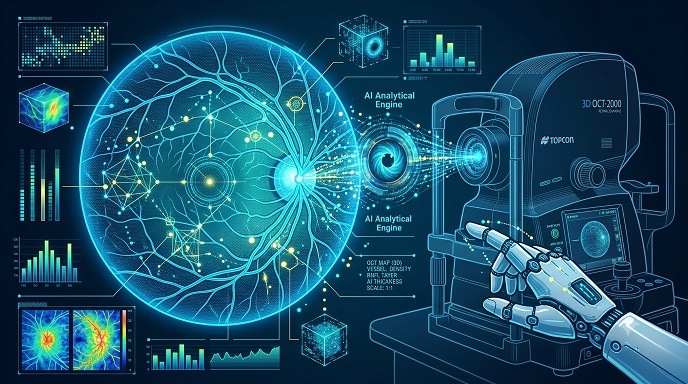
I know “artificial intelligence” sounds complicated. The process behind it, though, is pretty logical once you break it down.
Step one: gathering data. Researchers feed the system thousands of eye images: fundus photos, OCT scans, visual field tests, corneal images, and patient records. Experienced eye doctors label each one, marking what’s normal and what’s not.
Step two: training the model. The software studies these labeled examples over and over. Slowly, it starts recognizing the difference between a healthy retina and one showing early disease.
Step three: analyzing new images. When your scan gets uploaded, the AI compares it against everything it has learned. It might flag retinal swelling, damaged optic nerves, abnormal blood vessels, fluid buildup, or unusual lesions.
Step four: human review. Your doctor looks at both your original scan and the AI’s findings before saying anything definitive. This “human-in-the-loop” setup is what keeps the whole system safe.
AI-Assisted Care vs. Traditional Eye Exams
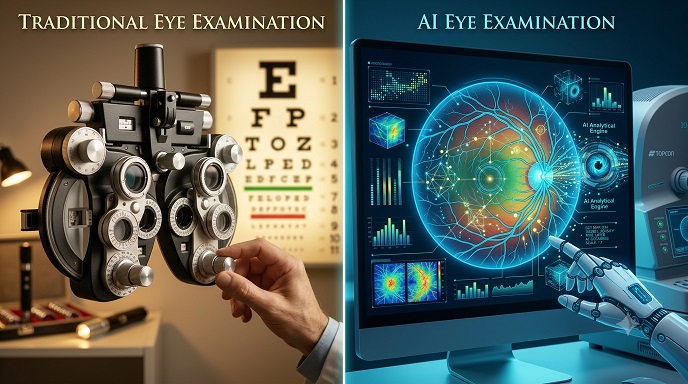
I don’t think of this as AI versus doctors. It’s really AI plus doctors.
| Feature | Traditional Exam | AI-Assisted Exam |
|---|---|---|
| Image analysis | Done manually by a specialist | Supported by software |
| Speed | Depends on how busy the clinic is | Usually much quicker |
| Consistency | Can vary between clinicians | Very consistent once validated |
| Disease screening | Manual interpretation | Automated pattern spotting |
| Final diagnosis | Made by the eye doctor | Made by the eye doctor, with AI input |
Neither approach wins on its own. Put them together, and you get faster screening without sacrificing clinical judgment.
A Quick History Lesson
People have been trying to teach computers to read eye scans since the 1980s. Those early attempts used rigid, rule-based programming, and honestly, they weren’t very good.
Things picked up in the early 2000s when machine learning entered the picture. Computers got better at noticing complex patterns in retinal photos instead of just following fixed rules.
The real leap happened between roughly 2015 and 2018. Deep learning arrived, and it changed everything. Instead of programmers writing rules by hand, these systems learned directly from massive image collections. Detection accuracy for diabetic retinopathy, glaucoma, macular degeneration, and even retinopathy of prematurity jumped noticeably.
Today’s platforms go even further. They combine retinal imaging with OCT interpretation, medical records, and risk prediction models to build a fuller picture of a patient’s eye health.
What Actually Happens During Your Appointment
Most patients never even notice AI is at work. It happens in the background.
Say you get a retinal photo or OCT scan taken. Within seconds, software might already be scanning that image, marking anything suspicious, before your doctor even walks into the room.
Patients tend to like this for a few reasons. Reports come back faster. Clinics can see more people without cutting corners. Problems get caught sooner. Follow-up appointments get scheduled more efficiently.
But here’s what I always tell people: AI cannot replace the conversation you have with your doctor. Your symptoms, your family history, your lifestyle, your actual physical exam — none of that shows up in a scan. That part of the process still needs a human.
Core Features Behind Modern Eye Care AI
| Feature | What It Does |
|---|---|
| Image recognition | Spots abnormalities in eye photos and scans |
| Pattern analysis | Catches subtle changes tied to disease |
| Risk prediction | Estimates the odds a condition will worsen |
| Automated screening | Helps prioritize patients needing urgent care |
| Clinical decision support | Gives doctors extra data during diagnosis |
| Workflow optimization | Cuts down on repetitive admin work |
| Remote monitoring | Powers telemedicine and rural screening |
These tools matter most in places where specialist eye care is scarce or clinics are overwhelmed with patients.
Is AI in Eye Care Actually Safe?
I’ll be straight with you: AI is a genuinely valuable clinical tool, but only when it’s been properly built, tested, and used under a qualified doctor’s supervision. It’s not magic, and it’s not infallible.
What it does well:
- Catches certain eye diseases earlier than they’d otherwise be found
- Speeds up how fast images get analyzed
- Keeps interpretation more consistent across different scans
- Frees up time in busy clinics
- Brings screening to remote or underserved areas
- Helps track disease progression over multiple visits
- Sometimes cuts down on unnecessary specialist referrals
Where it falls short:
- It needs high-quality images to work properly — garbage in, garbage out
- It can’t understand your symptoms or your full medical history on its own
- Accuracy can drop for populations underrepresented in its training data
- False positives and false negatives do happen
- It always needs a human to confirm findings before treatment starts
- Data privacy and cybersecurity are real concerns that clinics have to manage carefully
The safest setup pairs smart technology with an experienced clinician. Neither one alone gets you the best outcome.
Where AI Is Already Being Used in Eye Care
Diabetic Retinopathy Screening
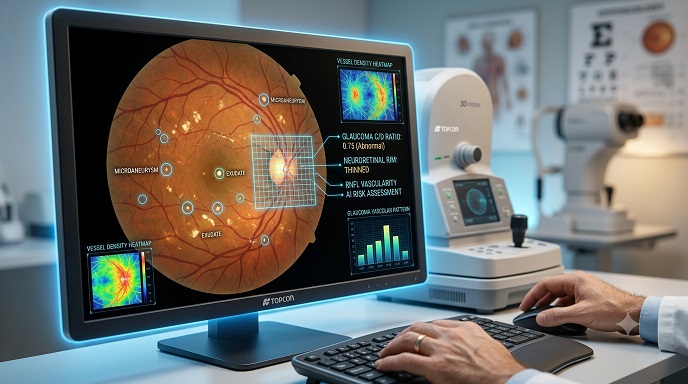
This is probably the biggest success story so far. AI scans retinal photos for tiny blood vessel changes tied to diabetes-related eye damage, flagging patients who need to see a specialist fast.
the first FDA-authorized autonomous AI diagnostic system
Glaucoma Detection
Glaucoma sneaks up on people. It rarely causes symptoms until vision loss has already started. AI examines optic nerve photos, OCT scans, nerve fiber layer measurements, and visual field results to flag patients who need closer evaluation.
Age-Related Macular Degeneration
AI looks for drusen deposits, retinal fluid, and geographic atrophy — signs that AMD may be progressing — and helps specialists track those changes visit after visit.
Cataract Evaluation
Researchers are building systems that grade cataract severity, analyze lens images, and even help calculate intraocular lens measurements before surgery.
OCT Scan Analysis
OCT produces detailed cross-sections of the retina. AI can scan these images fast, catching retinal swelling, fluid pockets, macular holes, and early structural damage that might take a human much longer to review.
Telemedicine and Remote Screening
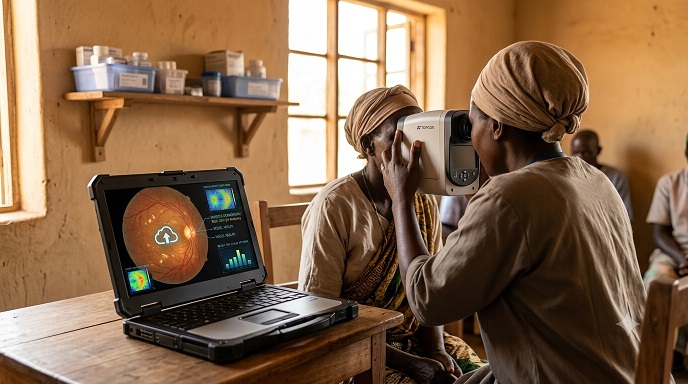
In rural areas with few eye specialists, a trained health worker can capture retinal images on-site while AI helps decide who needs to see an ophthalmologist. This alone is expanding access to eye care in places that badly need it.
Surgical Planning
Some newer systems help surgeons plan cataract procedures, predict outcomes, and support robotic-assisted surgery. This area is still developing, but early results look promising.
The Four Types of AI (And Which One Runs Your Eye Clinic)
AI generally gets sorted into four categories:
| Type | Description | Where It Stands Today |
|---|---|---|
| Reactive Machines | React to input with no memory of the past | Common today |
| Limited Memory AI | Learns from past data to improve | Most medical AI, including eye care |
| Theory of Mind AI | Would understand emotions and intentions | Still theoretical |
| Self-Aware AI | Hypothetical human-like consciousness | Doesn’t exist |
Eye care AI falls squarely into the Limited Memory category. It learns from mountains of past images and data, but it doesn’t reason or think the way a person does. It recognizes patterns. That’s it.
Can AI Cure Glaucoma?
No. Full stop.
Glaucoma damages the optic nerve, and that damage can’t be reversed. Treatment focuses on lowering eye pressure through medication, laser therapy, or surgery to slow things down.
What AI actually does is help catch glaucoma earlier and track it more closely. It can analyze optic nerve images, monitor structural changes, and flag patients at higher risk of getting worse. Earlier detection means treatment can start before major vision loss happens — but detection isn’t the same as a cure, and it never will be.
Is AI Coming for Optometrists’ Jobs?
I get asked this a lot, and I understand the worry. My honest take: probably not, at least not in the way people fear.
AI is good at image analysis, generating screening reports, organizing data, and automating repetitive tasks. It’s not good at running a full eye exam, diagnosing complicated cases, talking through treatment options with a worried patient, handling surgical decisions, or managing emergencies.
Empathy and judgment aren’t things you can code into a screening algorithm. If anything, AI frees up time so doctors can spend more of it actually talking to patients instead of buried in scans.
Getting the Most Out of AI in Eye Care
For clinics wanting to use this responsibly, a few things matter:
- Use high-quality imaging. AI performs only as well as the images it’s given.
- Never skip the clinical exam. Symptoms, history, and physical findings still count.
- Confirm anything abnormal. A flagged result needs a qualified doctor’s review before any treatment decision gets made.
- Track changes over time. AI shines when comparing scans across multiple visits.
- Protect patient data. Any clinic using AI needs to follow proper data security and privacy standards.
If you’re a patient, it’s fair to ask your clinic a few questions: How does this technology help my exam? Will my doctor personally review the AI results? Does this replace any part of my checkup? How is my data protected? Asking these things isn’t rude — it’s smart.
Myths People Still Believe About AI in Eye Care
“AI can replace my eye doctor.” It can’t. Doctors weigh symptoms, history, and physical exam findings that no algorithm sees.
“AI is always right.” No technology is perfect. Poor image quality, rare conditions, or unusual anatomy can all throw off results.
“I don’t need regular exams anymore.” You do. AI screening isn’t a substitute for a full eye exam with pressure checks and a proper physical evaluation.
“AI can cure eye diseases.” It can’t. It helps with detection and monitoring, not treatment.
“My data isn’t really at risk.” It is, if a clinic isn’t careful. Ask how your information is stored and protected.
Where This Technology Is Headed
I think the next few years will bring some genuinely useful changes.
Doctors may soon combine imaging with genetics and full medical history to build treatment plans tailored to each patient, rather than relying on general guidelines. AI models may also start predicting disease risk years before any damage shows up, which opens the door to real prevention instead of just early treatment.
Remote screening will likely keep expanding, especially in rural regions where seeing a specialist currently means a long drive or a long wait. Surgical robotics paired with AI could improve precision during delicate procedures. And behind the scenes, AI may take over more administrative grunt work — drafting notes, organizing scans, flagging urgent cases — so doctors spend less time on paperwork.
Even with all of that, human oversight isn’t going away. It shouldn’t.
Frequently Asked Questions
How is AI used in eye care? It analyzes retinal images and OCT scans to detect conditions like diabetic retinopathy, glaucoma, and macular degeneration. It also supports monitoring, surgical planning, and clinic workflow, always working alongside a qualified doctor.
What are the four types of AI? Reactive Machines, Limited Memory AI, Theory of Mind AI, and Self-Aware AI. Eye care AI belongs to the Limited Memory category.
Can AI cure glaucoma? No. It helps detect and monitor glaucoma earlier, but treatment still relies on medication, laser therapy, or surgery.
Is AI a threat to optometry? Not really. It automates repetitive tasks, but exams, diagnosis, and patient communication still require a trained professional.
Is AI accurate at detecting eye diseases? Often, yes, especially for retinal image analysis. Accuracy depends on image quality and proper clinical validation, and human review remains essential.
Will AI eventually replace ophthalmologists? Unlikely. AI handles data processing well; doctors handle judgment, empathy, and personalized care. The two work better together than either would alone.
A Quick Note on This Article
I put this guide together using publicly available research and widely accepted information about ophthalmology and AI. Technology in this space moves fast, so some details may shift as new studies come out. This isn’t medical advice. If you’re dealing with vision changes, eye pain, or any concerns about your eyes, talk to an actual ophthalmologist or optometrist who can examine you directly.
While AI can help doctors evaluate the severity of cataracts and support surgical planning, healthy daily habits still play an important role in protecting your vision. If you’re looking for practical ways to lower your risk, read our guide on How to Prevent Cataracts Naturally: 8 Proven Ways to Protect Your Vision.
Final Thoughts
AI in eye care has already proven itself useful — faster screening, more consistent image analysis, and better access for people who don’t live near a specialist. That’s not a small thing. For someone in a rural town who can now get screened for diabetic retinopathy without a three-hour drive, this technology is genuinely life-changing.
But I keep coming back to the same point: AI supports doctors, it doesn’t replace them. It can’t hold a conversation about your symptoms. It can’t examine your eye by hand. It can’t cure a single disease. What it can do is help catch problems earlier and give doctors more time to focus on you instead of routine scans.
As this field keeps growing, expect to see more personalized treatment planning, earlier risk prediction, and wider access to remote screening. Used the right way — with proper testing, privacy protection, and a doctor always double-checking the results — AI in eye care has real potential to protect vision for a lot of people who might otherwise go undiagnosed until it’s too late.