
I get it. Your eyes feel tired by 3 pm. Reading gives you a dull headache. Screens feel blurry no matter how you squint. So you start typing “eye exercises for astigmatism” into Google, hoping there’s a way out of glasses.
Here’s the honest answer: eye exercises won’t fix astigmatism. Nothing about blinking harder or rolling your eyes in circles changes the shape of your cornea. But that doesn’t mean these exercises are useless. Far from it. Used the right way, they can genuinely reduce eye strain, ease headaches, and make your whole day more comfortable.
Let me walk you through what’s real, what’s marketing hype, and which exercises are actually worth your five minutes.
Table of Contents
What Astigmatism Actually Is
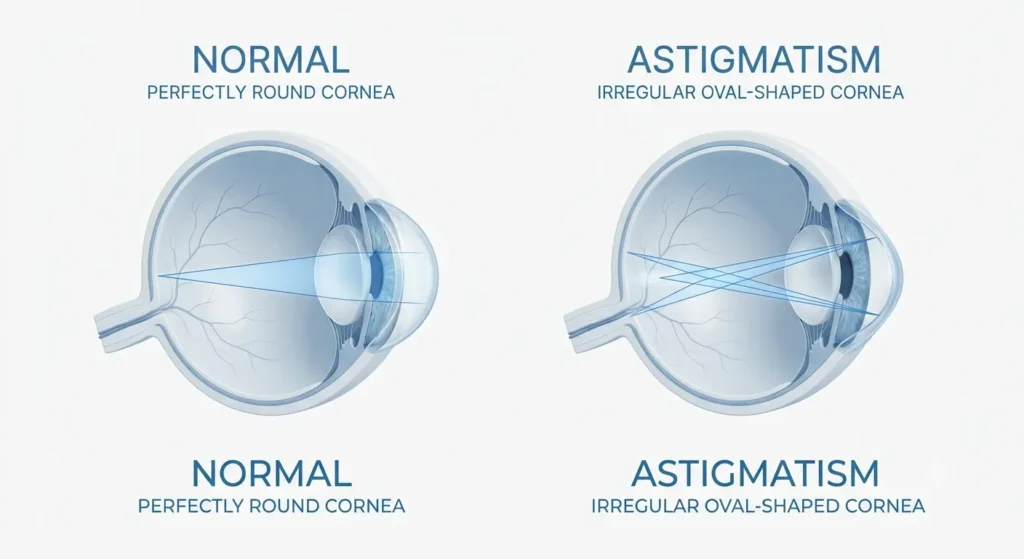
Picture a basketball. Now picture a football. Your cornea should be shaped like the basketball — round, even, smooth. With astigmatism, it’s shaped more like the football. Uneven. That irregular curve bends light in more than one direction instead of focusing it cleanly on your retina.
The result? Blur. Sometimes at a distance, sometimes up close, sometimes both. You might also deal with:
- Eye strain that builds up through the day
- Squinting without realizing it
- Headaches after reading or screen work
- Trouble seeing clearly at night
- Eyes that feel tired even after a full night’s sleep
Some people are born with astigmatism. Others develop it later from an eye injury, surgery, or gradual changes in the cornea. It often shows up alongside nearsightedness or farsightedness, which is why your eye doctor checks for all three at once.
The National Eye Institute explains that astigmatism occurs when the cornea or lens has an irregular curve, causing light to focus unevenly on the retina.
So What Do Eye Exercises Actually Do?
Think of eye exercises like stretching before a run. Stretching won’t change your bone structure. It won’t make you taller. But it loosens tight muscles and helps you move more comfortably. Eye exercises work the same way.
They can help with:
- Muscle fatigue after long screen sessions
- Sluggish focus-switching between near and far objects
- Dry eyes from forgetting to blink
- General visual tension and heaviness
What they cannot do is reshape your cornea or lens. That’s the part of the internet hype nobody wants to admit. If a website promises exercises will “cure” your astigmatism, that claim doesn’t hold up against the research.
Exercises vs. Real Treatment — Know the Difference
| Eye Exercises | Medical Treatment |
|---|---|
| Ease eye strain | Correct blurred vision |
| Improve visual comfort | Fix the refractive error itself |
| Build healthier visual habits | Sharpen visual clarity |
| Cannot reshape the cornea | Glasses, contacts, or surgery address the actual problem |
| May reduce fatigue | Deliver accurate, measurable correction |
These two things aren’t rivals. I’d actually encourage you to use both. Wear your prescribed glasses or contacts, and layer in exercises to cut down on the strain that builds up during the day.
What the Research Actually Shows
I won’t sugarcoat this. Scientific evidence doesn’t support the idea that eye exercises cure astigmatism. Researchers are consistent on this point: astigmatism comes from the physical shape of your cornea or lens, and no amount of eye movement changes that shape.
What actually corrects it? Glasses, toric contact lenses, orthokeratology for certain cases, and refractive surgery. Those are the proven paths.
That said, researchers do acknowledge something important. A lot of your discomfort — the strain, the dryness, the tension — comes from poor blinking habits and too many hours staring at screens without a break. Exercises that force you to pause, blink, and refocus can genuinely ease those symptoms, even though they leave the astigmatism itself untouched.
Scientific evidence doesn’t support the idea that eye exercises cure astigmatism. According to the American Academy of Ophthalmology, astigmatism is caused by the shape of the cornea or lens and cannot be corrected with eye exercises.
Comparing Your Options
| Method | Corrects Astigmatism? | Eases Strain? | Permanent? |
|---|---|---|---|
| Eye exercises | No | Yes, for many people | No |
| Glasses | Yes | Yes | No |
| Toric contacts | Yes | Yes | No |
| Orthokeratology | Temporarily | Yes | Temporary |
| Laser surgery | Yes (if eligible) | Yes | Usually long-lasting |
| Healthy habits | No | Yes | Ongoing |
This table tells the real story. Eye exercises play a supporting role. They’re not the main event.
What It Actually Feels Like
Most people don’t notice a dramatic shift. It’s subtle. You blink more naturally. Your eyes feel less “heavy” by evening. Reading feels a little smoother. That’s about it — and honestly, that’s enough. Nobody’s eyes should feel exhausted by 6 pm just from a normal workday.
Consistency beats intensity here. Five minutes daily does more for you than one long session once a week. I’d rather you do a two-minute blinking exercise every morning than a 20-minute routine you abandon after three days.
Why These Exercises Are Worth Doing Anyway
They force you to take breaks. Most adults stare at screens for eight-plus hours a day. Scheduled exercises build in natural pauses your eyes desperately need.
They fix your blinking. You blink about half as often while staring at a screen. That’s a huge reason your eyes feel dry and gritty by afternoon. Conscious blinking exercises correct this fast.
They improve focus flexibility. Shifting between near and far objects trains your eyes to change focus more smoothly, which matters if you go from a laptop to a phone to a whiteboard all day.
They support coordination. Your two eyes need to work together. Some of these exercises improve that teamwork, even without touching your prescription.
They require nothing. No gym membership. No equipment. Just a few free minutes and a quiet corner.
Quick Reference: The Facts
| Question | Answer |
|---|---|
| What causes astigmatism? | An irregular cornea or lens shape |
| Can exercises cure it? | No |
| Can exercises reduce strain? | Often, yes |
| How long should I practice? | About 5–15 minutes daily |
| Safe during computer work? | Yes |
| Do I still need glasses? | Usually, if prescribed |
| Best paired with? | Regular eye exams and healthy visual habits |
Are They Safe?
For most healthy adults, yes. Gentle eye exercises rarely cause problems. They’re worth adding to your routine if you deal with computer strain, reading fatigue, dryness, or general focusing discomfort.
But keep your expectations grounded.
What they can do: ease fatigue, build better blinking habits, remind you to take breaks, support comfortable focusing, cut down on screen-related discomfort.
What they can’t do: permanently correct astigmatism, replace your glasses or contacts, reshape your cornea, or substitute for professional care if your vision is changing.
Talk to an Eye Doctor First If You Have
- Vision that’s changing rapidly
- Recent eye surgery
- An eye injury
- Persistent double vision
- Glaucoma or a retinal disease
- Sudden eye pain or vision loss
Exercises are for comfort, not diagnosis. If something feels seriously wrong, skip the exercises and call your eye doctor.
The Best Eye Exercises for Astigmatism
Do these gently. Stop immediately if anything causes pain, dizziness, or worse vision.
1. The 20-20-20 Rule

The simplest habit on this list, and probably the most effective.
How:
- Work for 20 minutes.
- Look at something 20 feet away.
- Hold that focus for 20 seconds.
- Blink naturally, then get back to work.
Set a phone timer. You’ll forget otherwise — everyone does.
2. Near-and-Far Focusing
Trains your eyes to switch focus without straining.
How:
- Hold your thumb 10 inches from your face.
- Focus on it for 10–15 seconds.
- Shift focus to something 20 feet away.
- Hold for another 10–15 seconds.
- Repeat 10 times.
3. Conscious Blinking
Fixes the dryness caused by screen-staring.
How:
- Close your eyes for two seconds.
- Open slowly.
- Blink normally 10 times.
- Close again briefly.
- Repeat 5–10 times.
4. Palming

This is relaxation, not correction — but it works.
How:
- Rub your palms together until warm.
- Close your eyes.
- Cup your warm palms gently over them, no pressure.
- Keep it fully dark.
- Breathe slowly for 2–5 minutes.
5. Figure-Eight Eye Movement
Builds smoother eye control.
How:
- Picture a large figure eight about 8–10 feet away.
- Trace it slowly with your eyes only.
- Continue for a minute.
- Reverse direction.
- Repeat two or three times.
6. Thumb Tracking
How:
- Hold your thumb at arm’s length.
- Focus on the nail.
- Move it left, right, up, down, diagonally.
- Keep your head still — only your eyes move.
- Continue for about two minutes.
7. Gentle Eye Rolling
How:
- Sit upright, look up.
- Roll your eyes clockwise, slowly, five times.
- Reverse direction.
8. Reading Focus Exercise
How:
- Read a paragraph.
- Pause and look at something several feet away.
- Return to the book.
- Repeat for a few minutes.
A Simple Daily Routine
| Time | Activity | Duration |
|---|---|---|
| Morning | Blinking exercise | 2 minutes |
| Mid-morning | Near-and-far focusing | 3 minutes |
| Afternoon | 20-20-20 breaks | Throughout the day |
| Evening | Figure-eight movement | 2 minutes |
| Before bed | Palming | 5 minutes |
Notice what this routine isn’t trying to do — fix your astigmatism. It’s built for comfort, nothing more.
Habits That Make a Real Difference
Cut Down Continuous Screen Time
Take breaks. Bump up your text size. Position your monitor at eye level. Small adjustments add up fast.
Blink on Purpose
You blink about half as often while on a screen. That alone explains most of your dryness. Make blinking a conscious habit, not an afterthought.
Fix Your Lighting
Glare forces your eyes to work harder than they should. Reduce screen reflections, use proper reading light, and match your screen brightness to the room.
Eat for Your Eyes

| Nutrient | Food Sources |
|---|---|
| Vitamin A | Carrots, sweet potatoes, spinach |
| Omega-3s | Salmon, walnuts, flaxseed |
| Lutein | Kale, spinach, peas |
| Zeaxanthin | Corn, peppers, eggs |
| Vitamin C | Citrus fruits, strawberries |
| Zinc | Beans, seafood, pumpkin seeds |
No food fixes astigmatism. But a good diet keeps your eyes functioning at their best.
Drink Water, Sleep Enough
Dehydration and poor sleep both make eye strain worse. Aim for 7–9 hours of sleep and stay hydrated throughout the day.
Want to protect your vision even further? Healthy daily habits don’t just reduce eye strain—they may also help lower the risk of other age-related eye conditions. Read our guide on How to Prevent Cataracts Naturally: 8 Proven Ways to Protect Your Vision to learn practical ways to keep your eyes healthy for years to come.
Mistakes I See People Make
Expecting a cure. The research just isn’t there. Don’t chase it.
Ditching glasses mid-exercise-routine. This backfires. You’ll get more headaches, worse strain, and poorer vision — not less.
Going too hard. Eye exercises should never hurt. If you’re pressing on your eyes or forcing movements, stop.
Ignoring new symptoms. Sudden blur, double vision, flashes of light, or eye pain need a doctor, not another round of eye rolls.
Skipping breaks entirely. Short, frequent breaks beat one long break at the end of the day, every time.
Can You Stop Astigmatism From Getting Worse?
Partially, and it depends on the cause. For most people, astigmatism shifts gradually due to natural changes in the eye — not because of anything you did wrong. You can’t fully control that. But you can reduce unnecessary strain along the way.
Things that genuinely help:
- Wear your prescribed glasses or contacts consistently
- Get regular comprehensive eye exams
- Avoid rubbing your eyes hard — chronic rubbing can affect corneal health in some people
- Take real breaks during screen use
- Treat dry eyes if your doctor recommends it
- Wear safety eyewear when needed
- Manage conditions like diabetes well
- Eat well and stay active
If your vision starts changing fast, or your prescription keeps shifting, get in to see your eye doctor. Some corneal conditions need early treatment to prevent further damage.
What About the Bates Method?
You’ve probably seen this mentioned somewhere. Dr. William Bates developed this system in the early 1900s, built around the idea that relaxing your eyes could improve your eyesight. It includes palming, blinking, eye shifting, body swinging, and “sunning” — a controversial technique involving sun exposure with closed eyes that should never involve looking directly at the sun.
Some people feel more relaxed after trying it. Fair enough. But there’s no solid scientific evidence that the Bates Method corrects astigmatism or reshapes the cornea. Most eye doctors view it purely as a relaxation tool, not a treatment. If you want to try it, treat it as a comfort habit and keep following your optometrist’s actual advice.
Can Astigmatism Be Fixed Completely?
This depends on what “fixed” means to you.
Glasses and toric contacts correct how light enters your eye — you see clearly while wearing them. LASIK or PRK surgery actually reshapes the cornea and can offer long-lasting results for the right candidates. Some people still have minor residual astigmatism after surgery, and vision can shift again with age.
So instead of “100% cured,” I’d say astigmatism is usually well-managed or well-corrected. That’s a more honest way to put it. Your best option depends on your age, how severe your astigmatism is, your corneal thickness, your lifestyle, and how stable your prescription has been. Your eye doctor can walk you through which path fits you.
Can You Reduce Astigmatism Naturally?
Not the astigmatism itself — that comes down to your cornea’s shape, and nothing natural changes that. But you absolutely can reduce the symptoms naturally:
- Practice the 20-20-20 rule during screen time
- Do gentle relaxation exercises like blinking, palming, and focus shifts
- Wear your prescribed glasses so you’re not straining unnecessarily
- Eat foods rich in vitamins and antioxidants — leafy greens, citrus, fatty fish, nuts, eggs
- Stay hydrated for healthy tear production
- Sleep enough for your eyes to recover
- Reduce glare, increase text size, and take real breaks
- Avoid rubbing your eyes hard, especially if you’re prone to conditions like keratoconus
- Book regular eye exams to catch changes early
Frequently Asked Questions
Can eye exercises cure astigmatism? No. They can’t reshape your cornea or lens. What they can do is ease eye strain and build better visual habits.
How often should I do these exercises? Once or twice a day for the structured ones, with the 20-20-20 rule practiced throughout your workday. Doing a little consistently beats doing a lot occasionally.
What’s the best exercise for eye strain from astigmatism? There’s no single winner. Blinking exercises, near-and-far focusing, palming, and regular screen breaks all show up as favorites for a reason — they work.
Can kids with astigmatism do these exercises? Generally, yes, gentle versions are safe. But they should never replace a proper eye exam or prescribed glasses. Check with a pediatric eye doctor first.
Does screen time make astigmatism worse? Not the astigmatism itself. But it definitely worsens strain, dryness, headaches, and blur from prolonged focusing and reduced blinking.
When should I actually see a doctor? Book an exam if you notice growing blur, frequent headaches, trouble seeing at night, double vision, eye pain, sudden vision changes, or if your prescription keeps changing fast.
My Honest Take
Eye exercises for astigmatism aren’t a scam, but they’re also not a miracle cure. I’d never tell you to skip your glasses and rely on eye rolls instead — that’s a fast track to more headaches, not fewer.
What I would tell you: add these exercises into your day anyway. Blink more. Take real breaks. Try palming before bed. None of it reshapes your cornea, but all of it makes your eyes feel better right now, today, while you go about your normal life.
If you have astigmatism, your real fix is glasses, toric contacts, or surgery if you qualify. Everything else — the exercises, the diet, the sleep, the screen breaks — is there to support that treatment, not replace it.
Stay on top of your eye exams. Follow what your eye doctor actually recommends. Use these exercises as a comfort habit, not a cure. That combination gives you the best shot at clear, comfortable vision for the long run.
This article is for general informational purposes and isn’t a substitute for personalized medical advice. If you’re experiencing persistent blurry vision, eye pain, sudden vision changes, or flashes of light, see a qualified optometrist or ophthalmologist as soon as possible.