

Quick Answer: Left vision blurry usually means dry eyes, eye strain, or an outdated glasses prescription — and it clears up on its own within minutes to hours. But if the blur hits suddenly, comes with eye pain, flashes of light, or a headache, treat it as urgent and get checked by an eye doctor the same day.
I Get Why This Scares You
You wake up, blink twice, and one eye just won’t focus. The other eye is fine. That mismatch is what makes left vision blurry so unsettling — it doesn’t fit the usual “I probably need new glasses” story, because if that were the case, both eyes would be affected equally.
I’m going to walk you through left vision blurry the way I’d want it explained to me: no fluff, no scare tactics, just what’s actually going on and what to do about it.
Quick Summary
Here’s left vision blurry broken down at a glance before we go deeper:
| Cause | Dry eyes, eye strain, refractive error, cataract, retinal or nerve issue |
| Most Common | Dry eye, uncorrected refractive error, temporary eye strain |
| Emergency Signs | Sudden loss of vision, flashes, floaters, blind spots, eye pain with nausea, slurred speech |
| Treatment | Artificial tears, updated glasses, prescription eye drops, or surgery depending on cause |
| Doctor Visit | Same-day if sudden or paired with pain/neurological symptoms; routine if mild and improving |
Left Eye Blurry Vision — The Short Version
Left eye blurry vision, or what I’m calling left vision blurry throughout this guide, means the eyesight in that eye alone has gotten hazy, dim, or out of focus. This is blurred vision in one eye — sometimes it’s cloudy vision, like a fog rolled in. Sometimes it’s hazy vision, like looking through a smudged window. Sometimes it’s sudden blurry vision, sharp one moment and gone the next. And sometimes it’s temporary blurry vision that fixes itself within the hour.
Blurred eyesight like this can show up alongside other signals too — distorted vision where straight lines look wavy, blind spots that block part of your view, light sensitivity that makes bright rooms uncomfortable, watery eyes or excessive tearing, trouble focusing on a page, or genuine difficulty reading text you could read fine last week.
Here’s the thing nobody tells you upfront: which eye it is doesn’t matter medically. Your left eye and right eye are built the same way. What actually matters is:
- Did it happen suddenly or slowly?
- Is it one eye or both?
- Does it come with pain, flashes, blind spots, or a headache?
- Is it a one-off vision change or a pattern?
Answer those three questions honestly and you’re already halfway to knowing whether left vision blurry is a “drink some water and rest” problem or a “call the doctor today” problem.
Left Eye Blurry vs Right Eye Blurry — Does It Actually Matter?
Not really, and here’s why I say that with confidence. Left vision blurry and right eye blurry come from the exact same list of causes. Cataracts don’t prefer one side. Neither does dry eye. What changes the urgency isn’t which eye — it’s whether it’s isolated to one eye (called monocular blur) or spread across both.
| What You’re Noticing | One Eye Blurry | Both Eyes Blurry |
|---|---|---|
| Likely cause | Cataract, retinal issue, infection, corneal scratch | Old prescription, fatigue, dehydration, migraine |
| How it starts | Can hit suddenly (red flag) or build slowly | Usually gradual |
| Extra symptoms | Pain, floaters, flashes, redness in that eye only | Headache, tiredness, sensitivity to light |
| How worried should you be | Sudden one-eye blur deserves same-day attention | Usually less urgent |
If someone tells you “blurry vision in right eye” is somehow different from left, they’re wrong. Same structures, same risks, same rules.
Blurry Vision One Eye — Why It’s Actually the More Important Clue
Here’s my honest opinion: left vision blurry in one eye should get more of your attention, not less. When both eyes blur together, it’s often something systemic and mild — fatigue, blood sugar dips, dehydration. When it’s just one eye, something localized is happening inside that eye specifically. That’s not automatically dangerous, but it’s worth checking rather than shrugging off because “the other eye sees fine.”
Blurry Left Eye Suddenly — This Is the One to Take Seriously
If your vision went from clear to left vision blurry suddenly, within minutes or a couple of hours, don’t wait it out for days. Sudden blur is your eye’s way of raising a flag. It might be nothing more than a migraine aura passing through. It might also be a retinal tear, acute glaucoma, or even a stroke warning sign. I’d rather you get checked and it turns out to be nothing than skip the appointment and regret it.
Left Vision Blurry With a Headache — What’s Going On
Left vision blurry paired with a headache is one of the most common combos people search for, and it splits into a few very different explanations.
Migraine aura is the most frequent one. You might see zigzag lines, shimmering patches, or blind spots before or during the headache. It’s uncomfortable, but it typically fades within an hour on its own.
Eye strain headaches happen after hours of screens, reading, or driving. Your focusing muscles get tired, vision blurs, and tension creeps into a headache. I see this constantly with people who work at a desk all day and never look up.
Then there’s the serious end. A sudden, severe headache with blurry vision, plus confusion, weak arms or legs, or slurred speech, is a stroke warning. Don’t drive yourself to urgent care in that scenario — call emergency services. A headache with intense eye pain and nausea can also mean acute angle-closure glaucoma, which needs treatment fast to protect your sight.
A quick rule I trust: mild headache, brief blur, gone in an hour — probably fine. Severe headache, blur that lingers, other neurological symptoms — go get help now.
Why Is My Vision Blurry When I Wake Up?
This version of left vision blurry has a simple answer most of the time, and it’s not scary. Your eyes make less tear film while you sleep. Some people sleep with their eyelids slightly open without even knowing it. Both of these dry the surface of the eye overnight, and that dryness blurs vision until your eyes catch up.
A few other common reasons your vision is blurry after waking:
- Crusting or discharge collecting overnight, clearing once you blink or wash your face
- Corneal swelling, especially common in contact lens wearers, which settles within minutes
- Dehydration or low blood sugar, which affects clarity generally, not just mornings
- An outdated prescription, which becomes more obvious first thing in the day
If it clears in a few minutes and doesn’t come back, I wouldn’t stress about it. If it drags on for hours or happens every single day, that’s worth mentioning at your next eye exam.
How to Fix Blurry Vision After Waking Up
For mild left vision blurry after waking, here’s what actually helps:
- Blink repeatedly before you even get out of bed — it spreads tears across the eye fast.
- Keep preservative-free artificial tears on your nightstand if dryness is a regular issue.
- Press a warm, damp cloth over closed eyes for sixty seconds to loosen crusting.
- Drink water first thing — dehydration makes dry eye worse.
- Check your bedroom — a fan or AC blowing near your face dries eyes out overnight.
- Get your contact lens fit reviewed if you wear lenses, since a poor fit contributes to morning swelling.
None of that working? Stop guessing and book an eye exam instead.
Symptoms That Need Emergency Care — Don’t Wait on These
I want to be blunt here because this section matters more than any other on this page. Not every vision change is urgent, but some vision changes are your body’s way of asking for help right now. Get emergency care immediately if left vision blurry shows up with any of the following:
- Sudden, severe eye pain
- New flashes of light, blind spots, or a spike in floaters
- A shadow or curtain moving across part of your vision
- Nausea or vomiting alongside eye pain
- Halos around lights, especially paired with a headache
- Slurred speech, facial drooping, or weakness on one side
- Any sudden loss of vision, even brief loss of vision that comes back
- Distorted vision where lines suddenly look bent or wavy
- A recent hit or injury to the eye or head
These point to retinal detachment, acute glaucoma, or stroke — conditions where minutes genuinely matter for saving your vision or your life. If blurry vision is accompanied by seeing flashes of light or a sudden increase in floaters, seek emergency eye care.
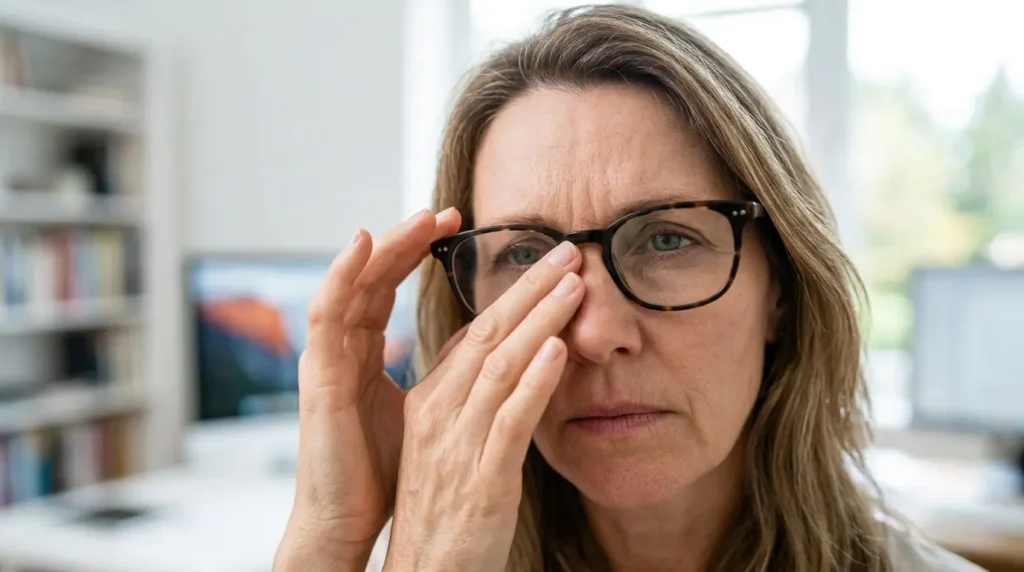
Common Causes of Left Vision Blurry
Refractive error (nearsightedness, farsightedness, astigmatism, presbyopia) — the most common cause overall, fixed with glasses or contacts.
Dry eye syndrome — poor tear quality, worse with screens or air conditioning. This one is far more common than people realize. Global prevalence estimates for dry eye disease range widely depending on how it’s diagnosed, but several large studies put it anywhere from roughly 10% to over 30% of adults, with women and people over 50 affected more often (Papas, 2021, Ophthalmic and Physiological Optics).
Eye strain — too many hours of close-up focus without breaks. Trouble focusing and difficulty reading small text late in the day are classic signs. Prolonged screen use can contribute to eye strain, dryness, and temporary blurry vision. Learn more about digital eye strain from the American Academy of Ophthalmology’s EyeWiki
Migraine aura — temporary visual disturbance, usually resolves within an hour.
Cataract — clouding of the lens, often progresses faster in one eye than the other. This is worth taking seriously: cataracts remain the single leading cause of blindness worldwide, responsible for somewhere between 45% and 51% of global blindness cases according to World Health Organization estimates (WHO / GBD 2020 data).
Conjunctivitis or eye infection — blur paired with redness, discharge, watery eyes, or irritation.
Corneal abrasion — a scratch or trapped debris causing sudden discomfort and blur.
Keratitis — inflammation or infection of the cornea, often linked to contact lens overuse, causing pain, light sensitivity, and blurred eyesight.
Diabetic retinopathy — blood sugar swings damaging retinal blood vessels over time.
Macular degeneration — affects central, detailed vision, often starting in one eye first.
Retinal detachment or tear — a true emergency, usually with flashes, floaters, and blind spots.
Posterior Vitreous Detachment (PVD) — the gel inside the eye pulls away from the retina as part of normal aging. Usually harmless, but a sudden spike in floaters or flashes needs an exam to rule out a retinal tear.
Retinal Vein Occlusion — a blocked vein in the retina, causing sudden, often painless blurred vision in one eye.
Retinal Artery Occlusion — a blocked artery in the retina, essentially a “stroke of the eye” — sudden, painless vision loss that needs emergency treatment within hours.
Central Serous Retinopathy — fluid builds up under the retina, causing distorted or blurred central vision, often linked to stress or steroid use.
Acute angle-closure glaucoma — sudden pressure spike inside the eye, needs urgent treatment.
Optic neuritis — inflammation of the optic nerve, sometimes an early sign of multiple sclerosis, especially in younger adults with sudden vision changes and eye pain on movement.
Uveitis — inflammation inside the eye that can blur vision and cause light sensitivity.
High blood pressure — can affect the tiny blood vessels feeding the retina over time.
Stroke or TIA — brief or lasting disruption in blood flow to the brain’s vision centers.

How Doctors Diagnose Blurry Vision
An eye doctor doesn’t guess when you show up describing left vision blurry — a proper eye examination runs through a specific process:
- Visual acuity test — reading a chart to measure current sharpness
- Refraction test — checking whether a prescription change would fix things
- Tonometry — measuring eye pressure to screen for glaucoma
- Dilated fundus exam — widening the pupil so the doctor can directly inspect the retina and optic nerve at the back of the eye
- Slit-lamp exam — close inspection of the cornea and lens
- OCT scan — detailed imaging of the retina and optic nerve for swelling, fluid, or structural damage
- Bloodwork or corneal topography — used when the exam points toward something systemic
A full eye examination is the only reliable way to tell a harmless cause from something that needs treatment — no home test can look at your retina or optic nerve the way a dilated exam can.
Treatment Options
Treatment for left vision blurry always depends on the cause, not the symptom alone:
- Refractive error — updated glasses, contacts, or refractive surgery
- Dry eye — artificial tears, warm compresses, lifestyle changes
- Eye strain — regular breaks and the 20-20-20 rule (every 20 minutes, look 20 feet away for 20 seconds)
- Infections — prescription eye drops or oral medication
- Cataracts — monitored until surgery becomes the right call
- Diabetic changes — blood sugar management plus targeted eye treatment
- Emergencies — retinal detachment and acute glaucoma need specialist care, often within hours

Can Left Vision Blurry Go Away on Its Own?
Sometimes, yes. Blur from mild dryness, short-term eye strain, or a passing migraine aura often resolves within an hour without any treatment. But blur caused by something structural — cataracts, retinal damage, glaucoma, diabetic changes — won’t fix itself. It tends to get worse the longer it’s ignored.
My rule of thumb: quick and gone, probably fine. Lingering, repeating, or paired with warning signs — get it looked at.
Prevention Tips for Left Vision Blurry
A little routine goes a long way toward keeping left vision blurry from becoming a recurring problem:
- Practice the 20-20-20 rule during screen-heavy days
- Book comprehensive eye exams even when nothing feels wrong
- Keep diabetes and blood pressure under control
- Stay hydrated and keep a consistent sleep schedule
- Use decent lighting when reading or working
- Wear sunglasses that actually block UV rays
- Skip smoking — it raises your risk for several eye diseases
- Update your glasses or contacts prescription on schedule

Mistakes People Make With Left Vision Blurry
- Not tracking whether the blur is constant, on-and-off, or worsening
- Ignoring one eye blurry vision because “the other eye is fine”
- Waiting days when pain or flashes call for same-day care
- Blaming everything on tiredness without checking further
- Skipping annual exams, especially with diabetes or a family eye history
Choosing the Right Eye Care for Left Vision Blurry
Pick an optometrist or ophthalmologist who does a full exam, not a five-minute chart reading. For sudden or severe symptoms, head straight to urgent or emergency eye care — don’t wait for a routine slot to open up. Walk in with a clear timeline: when it started, how long it lasts, what makes it better or worse. If you wear contacts, mention the type and how long you’ve worn them, since that changes the likely cause.
Frequently Asked Questions
Why is my left vision blurry? Most often left vision blurry is dry eyes, eye strain, or a prescription that needs updating. Less commonly, it’s an infection, refractive shift, or a retinal issue. What caused it usually shows itself in how it started and what else is going on alongside it.
Why is only one eye blurry? One eye blurry vision usually points to something specific to that eye — a cataract, corneal problem, or retinal issue — rather than a general vision need that would affect both eyes at once.
Can stress cause blurry vision? Yes, indirectly. Stress drives eye strain, tension headaches, and poor sleep, and all three can make your vision feel less sharp temporarily.
Can dehydration cause blurry vision? It can. Dehydration cuts down tear production and general eye comfort, which makes vision feel hazy until you rehydrate.
Why is my vision blurry after waking up? Overnight dryness is the top reason. Tear production slows during sleep, and some people sleep with eyes slightly open, both of which cause temporary blur that clears within minutes.
Can a headache cause blurry vision? Migraines are the most common headache type linked to vision changes, though tension headaches and eye strain can produce a milder version of the same thing.
Is blurry vision an emergency? Not always — but sudden blur with eye pain, flashes, floaters, a curtain-like shadow, or symptoms like slurred speech absolutely is. Treat those combinations as urgent.
When should I see an eye doctor? Anytime blur is sudden, sticks around, gets worse, or shows up with pain, redness, flashes, or a headache. Even a mild pattern that keeps repeating deserves a real exam.
Why is my vision blurry all of a sudden? Sudden blurry vision usually comes from one of a few things: a migraine aura passing through, a spike in eye pressure, a retinal problem, or in rarer cases a blood flow issue affecting the eye or brain. Because the sudden version can be time-sensitive, I’d treat it as worth checking same-day rather than waiting to see if it fades.
Can blurry vision go back to normal? Often, yes. Temporary blurry vision from dryness, strain, or a brief migraine tends to return to normal on its own. Blur from a structural cause — a cataract, retinal damage, or nerve inflammation — needs treatment before it improves, and won’t just reverse itself.
Does blurred vision in one eye mean a stroke? Not usually, but it can be a symptom. Most one-eye blur comes from something local to the eye, not the brain. What raises stroke concern is sudden blur paired with slurred speech, facial drooping, confusion, or weakness on one side of the body. Any of those together is an emergency, full stop.
Why does my left eye feel like there is something in it and blurry? That “something in my eye” feeling combined with blur is often a sign of a corneal abrasion, foreign body, dry eye, or early conjunctivitis. Don’t rub it — rubbing can worsen a scratch. If it doesn’t clear after rinsing with saline or artificial tears within a short while, get it checked, since a scratched cornea can become infected if ignored.
My Bottom Line
Left vision blurry can be nothing — dry eyes, tiredness, a screen-heavy afternoon. It can also be your body telling you something needs attention now. The pattern tells you which one it is: how fast it started, whether it’s getting better or worse, and whether pain, flashes, or a headache came along for the ride. When in doubt, don’t guess. Get an eye doctor to actually look. That’s the difference between catching something early and wishing you had.
This article is for general information only and doesn’t replace a professional eye exam. If your symptoms are new, worsening, or concerning, see an eye doctor or another qualified healthcare provider.