


I want to start with something I tell every patient who walks in worried about floaters: you did the right thing by paying attention. Most floaters are nothing. But some aren’t. And you can’t tell the difference just by looking in the mirror.
That’s the whole point of eye exams for floaters. They’re not about vanity or routine box-checking. They’re about ruling out the handful of conditions that can steal your vision if nobody catches them in time.
Let me walk you through what these exams involve, why doctors take them seriously, and when you genuinely need to stop putting one off.
Table of Contents
What Floaters Actually Look Like
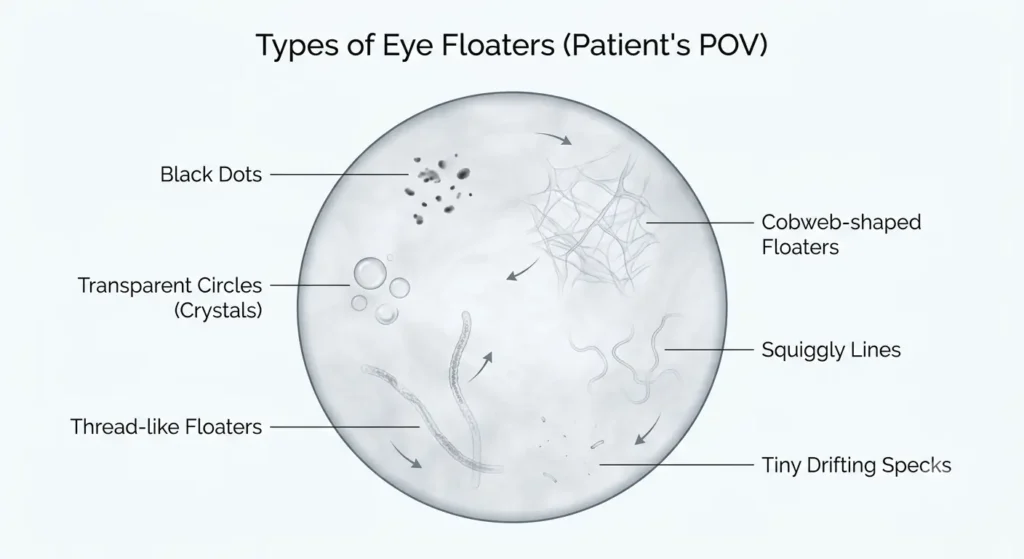
You know the moment. You’re staring at a bright sky, or a blank Word document, or your bathroom wall, and something drifts across your view. It’s not on the wall. It’s inside your eye.
People describe them in all sorts of ways:
- Small gray or black dots
- See-through circles
- Threads or squiggly lines
- Cobwebs
- Tiny specks that dance when you move your eyes
Here’s the strange part. Try to look directly at one, and it slides away. That’s because floaters aren’t stuck to your retina. They’re suspended in the vitreous, the clear gel filling most of your eyeball, and they move whenever your eye moves.
Why Floaters Show Up in the First Place
Aging is the biggest culprit, by far. As you get older, the vitreous gel starts to shrink and get watery in places. Collagen fibers inside it clump together. Those clumps cast shadows on your retina. That’s a floater.
But aging isn’t the only cause. Other things that bring on floaters include:
- Nearsightedness (the more severe, the higher the risk)
- Posterior vitreous detachment
- Past eye surgery
- A blow to the eye
- Inflammation inside the eye, called uveitis
- Bleeding inside the eye
- Retinal tears or detachment
- Diabetic eye disease
Most of these causes are harmless. A few are emergencies. That’s exactly why guessing isn’t good enough.
Learn more about the common causes and symptoms of eye floaters from the American Academy of Ophthalmology.
Why an Eye Exam for Floaters Actually Matters
Here’s something that surprises people: a retinal tear can feel almost identical to ordinary floaters at first. Same specks. Same drifting shapes. No pain at all, usually.
The only way to tell them apart is a proper look inside your eye. A trained eye care provider examines the retina and vitreous directly, checking for damage that you’d never notice on your own.
Conditions an exam can catch early include:
- Retinal tears
- Retinal detachment
- Bleeding in the vitreous (vitreous hemorrhage)
- Posterior vitreous detachment
- Inflammatory eye disease
- Diabetes-related eye damage
Catch these early, and treatment usually works well. Wait too long, and your options shrink.
Red Flags You Should Never Brush Off
Most floaters that have been around for months or years, unchanged, aren’t urgent. Your eye doctor will likely just keep an eye on them during your regular visits.
But certain symptoms need attention right away, not next month. Call your eye doctor if you notice:
- A sudden burst of new floaters, more than usual
- Flashes of light, especially in your side vision
- A dark curtain or shadow creeping across your view
- Vision that suddenly gets blurry
- Loss of peripheral vision
- Floaters after getting hit in the eye
- Floaters after recent eye surgery
- Floaters along with eye pain or redness
None of these guarantee something serious is wrong. But they’re worth checking, fast.
How This Differs From Your Regular Eye Exam
A standard vision checkup and a floater-focused exam overlap, but they’re not the same thing. The floater exam digs deeper into the back of your eye.
| Feature | Routine Eye Exam | Eye Exam for Floaters |
|---|---|---|
| Vision prescription check | Yes | Yes |
| Eye pressure check | Usually | Usually |
| General eye health check | Yes | Yes |
| Dilated retinal exam | Sometimes | Almost always |
| Vitreous evaluation | Brief | Thorough |
| Retinal tear screening | Only if flagged | Main focus |
| Peripheral retina check | Basic | Extensive |
| Emergency retinal assessment | Not typical | Yes, if symptoms call for it |
If floaters brought you in, expect more time spent on the back of your eye than you’d get at a normal checkup.
Walking Through the Exam, Step by Step
First, Your Doctor Asks Questions
This part matters more than people expect. Your doctor will want to know:
- When the floaters started
- Whether they came on suddenly or built up slowly
- If you’ve noticed flashes
- Whether one eye or both are affected
- If the number of floaters has grown recently
- Any history of eye trauma
- Whether you have diabetes or high blood pressure
- Past eye surgeries
Your answers help your doctor decide how urgently to move.
Then, a Vision Check
A standard eye chart test. Floaters usually don’t blur your vision much on their own, but this test flags anything unexpected going on alongside them.
Pupil Dilation, the Most Important Step
If your floaters are new, expect dilating drops. These enlarge your pupils so your doctor can see far more of your retina than would otherwise be visible.
Dilation lets your doctor:
- See more of the retina, including hard-to-reach edges
- Spot retinal tears that would otherwise hide
- Check the peripheral retina properly
- Notice bleeding or inflammation
- Assess the vitreous gel in detail
Your pupils stay dilated for a few hours afterward. Bright light will bother you, and reading small text gets tricky for a while.
Slit-Lamp Exam

This uses a specialized microscope to examine the front and middle of your eye up close. It’s quick, completely painless, and can reveal collagen clumps or inflammatory cells in the vitreous.
Retinal Examination
Once you’re dilated, this is where the real work happens. Using special lenses and bright light, your doctor scans your retina for:
- Tears
- Holes
- Detachment
- Traction from the vitreous pulling on the retina
- Bleeding
- Areas of degeneration
Catching any of these early genuinely changes the outcome.
Extra Imaging, If Needed
Not everyone needs this, but your doctor might order:
- Optical Coherence Tomography (OCT)
- Wide-field retinal photography
- Ocular ultrasound, if the retina is hard to see clearly
- Fundus photography
These give a more detailed record and help track changes over time.
Modern diagnostic tools powered by artificial intelligence are also helping eye specialists detect retinal diseases earlier and more accurately. Learn how AI in Eye Care: How It’s Transforming Vision Care Today is changing modern eye diagnosis.
What Your Doctor Might Actually Find
Posterior Vitreous Detachment (PVD)
Past age 50, the vitreous naturally starts pulling away from the retina. It’s the most common reason for new floaters at that age. Usually harmless on its own, but it can occasionally tug hard enough to tear the retina, which is exactly why it gets checked.
Retinal Tear
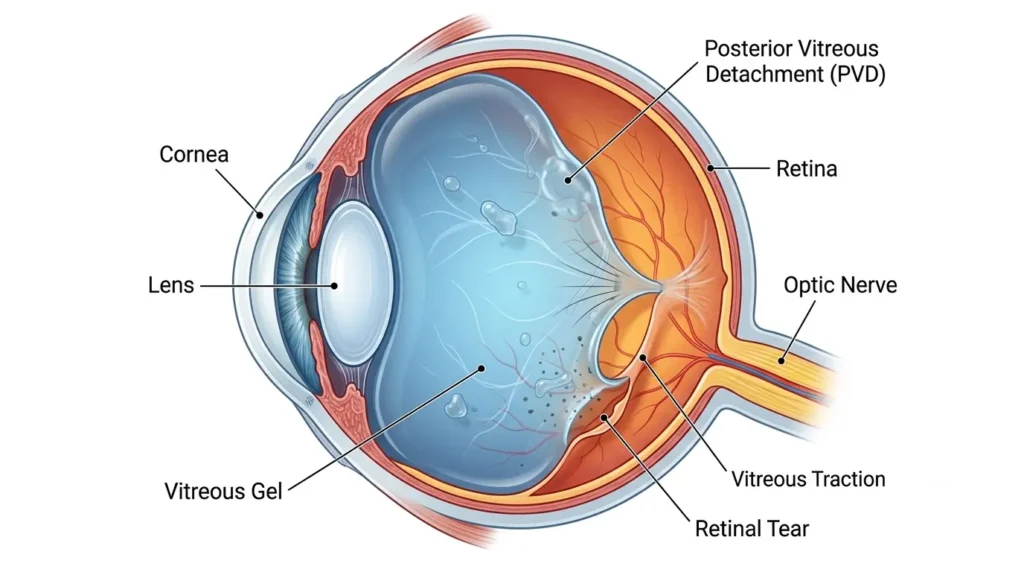
This happens when the vitreous pulls too hard on the retina. Small tears might only cause a few extra floaters or flashes. Left alone, they can progress into a full detachment.
Retinal Detachment
This one’s an emergency, full stop. Warning signs include a sudden flood of floaters, bright flashes, a curtain-like shadow, and sudden vision loss. Every hour matters here.
Read more about the symptoms and treatment of retinal detachment from the National Eye Institute.
Vitreous Hemorrhage
Bleeding inside the vitreous can look like a cloud of dark floaters or generally hazy vision. Causes range from diabetes to injury to abnormal blood vessels. Treatment depends entirely on what’s causing the bleed.
What the Appointment Actually Feels Like
I won’t pretend the drops feel great. They sting for a couple seconds. That’s about it.
After dilation, expect:
- Blurry close-up vision
- Sensitivity to bright light
- Floaters looking more obvious, since more light is hitting your retina
- Trouble reading fine print for a few hours
Most people go straight back to their day afterward. Just bring sunglasses.
Quick Reference
| Detail | What to Expect |
|---|---|
| Main purpose | Find the cause of floaters, check retinal health |
| Who performs it | Optometrist or ophthalmologist |
| Most important test | Dilated retinal exam |
| Typical length | 30 to 60 minutes |
| Pain level | Painless |
| Dilation needed? | Usually, especially with new floaters |
| Side effects | Light sensitivity, blurry near vision |
| Follow-up | Depends on what’s found |
| Urgency | Immediate if flashes or vision loss appear |
Is This Exam Actually Safe?

Yes. There’s no downside to having your eyes checked. The exam doesn’t harm your eye in any way. It just gives your doctor a clear view of what’s really going on.
Most people leave relieved, knowing nothing serious is happening. When something is found, catching it early is almost always better than catching it late.
One thing worth remembering: this exam diagnoses the cause of floaters. It doesn’t get rid of them. Its job is figuring out why they’re there.
Who Should Book This Exam
Book an exam if you:
- Just developed new floaters
- Noticed a sudden jump in the number of floaters
- See flashes of light
- Have blurry vision alongside floaters
- Are over 50
- Have significant nearsightedness
- Have diabetes
- Recently had cataract surgery
- Suffered an eye injury
- Have a family history of retinal disease
Mild symptoms are still worth checking. Waiting rarely helps, and it can occasionally hurt.
Regular comprehensive eye exams can detect more than floaters—they also help identify silent eye diseases. Read Early Signs of Glaucoma in Women: 7 Symptoms You Should Never Ignore to learn why early detection matters
Who Needs Closer Monitoring
Some people carry higher risk and benefit from more frequent checks:
- People with severe myopia
- Anyone with a history of retinal tears
- Diabetic patients with eye involvement
- People who’ve had retinal surgery
- Those with recurring vitreous hemorrhage
- Anyone with inherited retinal conditions
Your doctor can tell you how often you personally should come back.
Getting Ready for Your Appointment
Track your symptoms. Note when floaters started, whether one or both eyes are affected, whether they’re increasing, and whether flashes accompany them.
Bring your medical history. Past surgeries, injuries, current medications, diabetes, blood pressure issues, autoimmune conditions, anything relevant.
Pack sunglasses. Dilated pupils and sunlight don’t mix well.
Think about a ride home. Most people can drive after dilation, but if bright light really bothers you, having someone drive is smart.
Prepare a few questions. Ask what’s causing your floaters, whether they’ll fade, whether your retina looks healthy, and whether you need a follow-up.
After the Exam
- Keep sunglasses on outdoors
- Don’t rub your eyes
- Give your vision time to settle before reading small text
- Follow whatever instructions your doctor gives
- Call your clinic if anything new shows up afterward
Dilation effects fade within a few hours for almost everyone.
If Everything Looks Normal
Your doctor will probably suggest routine monitoring and regular comprehensive exams going forward. Most people stop noticing long-standing floaters over time. Your brain genuinely tunes them out.
If Something Is Found
Depending on what’s discovered, you might get:
- A referral to a retina specialist
- Laser treatment for a tear
- Scheduled observation
- Medication for inflammation
- Surgery, in cases like retinal detachment
Treatment targets the underlying cause, not the floaters themselves.
Mistakes People Make Constantly
Ignoring a sudden flood of new floaters. Waiting weeks can delay catching something that’s much easier to treat early.
Assuming every floater is just aging. Tears, bleeding, inflammation, and injury can all mimic ordinary age-related floaters. Only an exam tells them apart.
Skipping dilation because it’s inconvenient. I get it, nobody enjoys blurry vision for an afternoon. But dilation is often the difference between spotting a peripheral tear and missing it entirely.
Not mentioning flashes. Lightning-like streaks, brief bursts of light, increasing flash frequency, all of this matters. Say it out loud, even if it seems minor.
Waiting until vision actually worsens. By then, damage may have already progressed. Earlier is safer, always.
Skipping follow-ups. Even a clean first exam doesn’t rule out a tear developing later. Follow-up visits catch what the first exam couldn’t.
Choosing the Right Eye Doctor
Look for someone with real experience handling floaters, flashes, and retinal conditions, not just glasses prescriptions.
Check whether the clinic has access to imaging tools like OCT, digital retinal photography, wide-field imaging, or ocular ultrasound. Not every case needs these, but it helps when they’re available.
A solid exam covers medical history, vision testing, eye pressure, a slit-lamp look, dilated retinal exam, and clear follow-up guidance.
And honestly, communication matters just as much as equipment. A good doctor explains what’s causing your floaters, whether more testing is needed, what symptoms to watch for, and when to come back.
When to Treat It as an Emergency
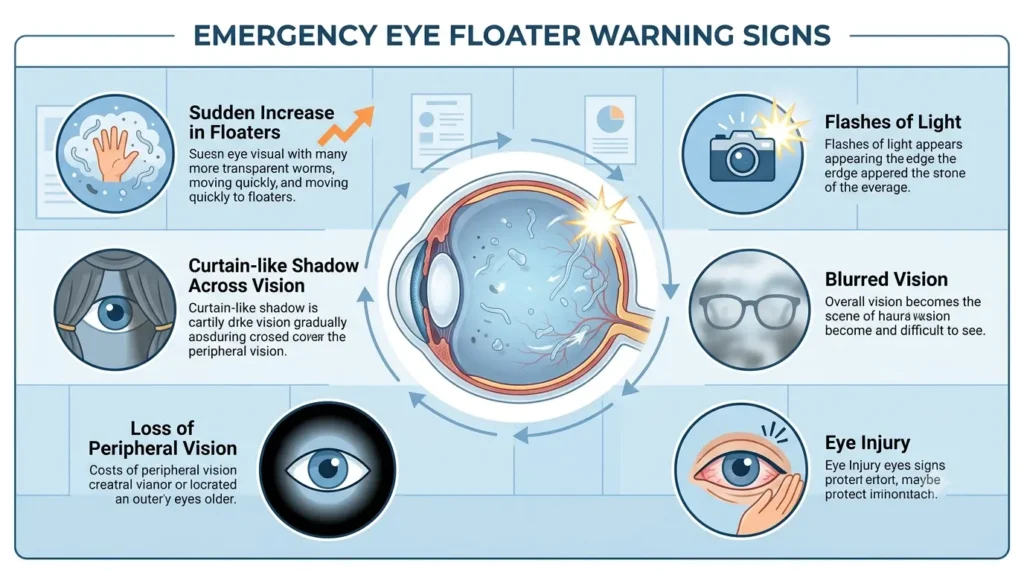
Get seen urgently if you notice:
- A sudden shower of floaters
- New or worsening flashes
- A shadow or curtain across your vision
- Sudden loss of peripheral vision
- Serious blurred vision
- Floaters right after an injury
- Floaters with real eye pain
- Floaters after recent surgery, paired with vision changes
Getting checked doesn’t mean something’s definitely wrong. It just rules out the things that would be dangerous to miss.
Living With Floaters That Turned Out Harmless
If your exam comes back clean, here’s what actually helps day to day:
- Move your eyes up and down to shift a floater out of your direct line of sight
- Take breaks from screens
- Wear sunglasses if glare makes floaters stand out more
- Keep up with routine eye exams
- Manage diabetes or blood pressure, since both affect eye health
- Get checked again fast if anything changes suddenly
Give it time. Most people stop noticing floaters that have been stable for a while. Your brain adapts faster than you’d think.
Common Questions People Ask
Can a regular eye exam catch floaters? Often, yes, especially if it includes a dilated look at the retina. Your doctor can see changes in the vitreous and judge whether they’re age-related or something else. New floaters usually prompt a closer look.
What exactly will the doctor do? They’ll review your history, check your vision, dilate your eyes, examine the retina and vitreous, and look for tears, bleeding, inflammation, or detachment. If everything’s fine, you’ll likely just get a monitoring plan.
Do I actually need a test for floaters? If they’re new, increasing, or paired with flashes, blurred vision, or a shadow, yes. Long-standing, unchanged floaters are usually low-risk, but still worth mentioning at your regular checkup.
Can the exam itself cause floaters? No. Dilation just makes existing floaters more visible temporarily, since more light reaches your retina. If a flood of new floaters shows up after your visit and doesn’t fade, or comes with flashes, call your doctor.
How long does it take? Usually 30 to 60 minutes. Dilation adds time since the drops need a few minutes to work before the exam can proceed.
Does everyone need treatment? No. Most age-related floaters just get monitored. Treatment comes into play only when floaters seriously affect vision or trace back to tears, inflammation, or bleeding.
Do floaters ever disappear on their own? Not always completely, but many fade into the background over time. Some settle lower in the eye. Others just become something your brain stops flagging. Sudden worsening, though, deserves an exam right away.
Are floaters always serious? No, most aren’t. But sudden changes, especially paired with flashes or vision loss, can point to a retinal tear or detachment. Since symptoms alone can’t tell you which situation you’re in, an exam is the only way to know for sure.
A Quick Honest Note
This article gives you general information based on common ophthalmology knowledge. It’s not a diagnosis, and it’s not a substitute for a real exam with a licensed optometrist or ophthalmologist. Only they can tell you what’s actually happening in your eye.
If you’re dealing with sudden new floaters, flashes, a shadow across your vision, or any sudden vision loss, don’t wait around reading articles. Get seen.
Bringing It All Together
Floaters are common. Most are harmless. But you genuinely can’t tell harmless from dangerous just by watching them drift across your vision.
An eye exam for floaters gives you an actual answer. Dilation, a careful look at your retina, and a review of your symptoms together tell your doctor whether you’re dealing with normal aging or something that needs quick action.
Learn the warning signs. Sudden floaters, flashes, a curtain-like shadow, blurred vision, all worth a same-week appointment, sometimes same-day.
If your floaters are old and stable, routine exams and basic monitoring are usually all you need. Either way, paying attention now protects your vision later. That’s worth more than any amount of worrying about it alone.