
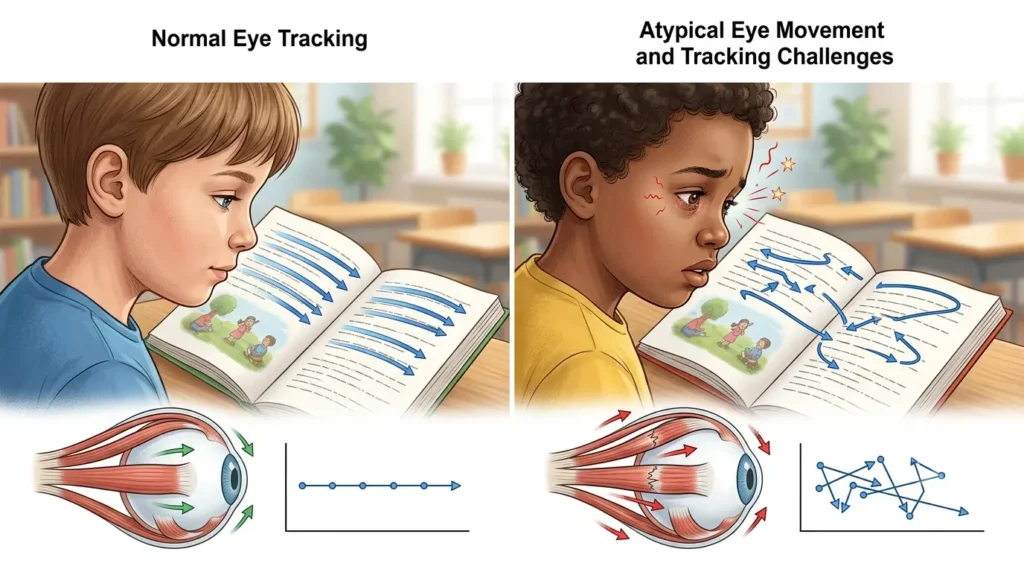
Quick answer : What are eye tracking problems? Eye tracking difficulties happen when your eyes can’t move smoothly and accurately between points of focus. Your eyesight can be perfectly clear, but your eye muscles struggle to coordinate with your brain. Reading, copying from a board, or following a moving object becomes exhausting. Kids skip lines. Adults reread the same sentence five times. It’s not laziness. It’s a movement issue, not a clarity issue.
I want to start with a question. Does your child lose their place while reading? Do they use a finger to track words long after their classmates stopped doing that? Or maybe it’s you. Maybe you reread the same paragraph three times and still don’t remember what it said. Maybe screens make you dizzy after twenty minutes.
Eye care professionals commonly see this pattern during functional vision assessments. Parents blame laziness. Adults blame stress. Teachers blame poor focus. But the real answer, in a lot of these cases, is eye tracking problems. And almost nobody talks about it, because a standard eye exam won’t catch it.
Let me break down what’s actually going on.
What Are Eye Tracking Problems?
Eye tracking problems (also called eye movement problems or oculomotor dysfunction) mean your eyes struggle to move accurately, quickly, and smoothly between two points. This isn’t about how sharp your vision is. It’s about coordination.
Your eyes rely on two main types of movement:
- Pursuits — smooth tracking of a moving object, like watching a car drive past
- Saccades — quick jumps from point to point, like jumping from word to word on a page
When these movements are off, even slightly, your brain gets scrambled visual input. You can pass a 20/20 eye chart with flying colors and still have serious eye tracking issues and reading difficulties. That’s the trap. Nobody thinks to test for it because “the eye exam came back fine.”
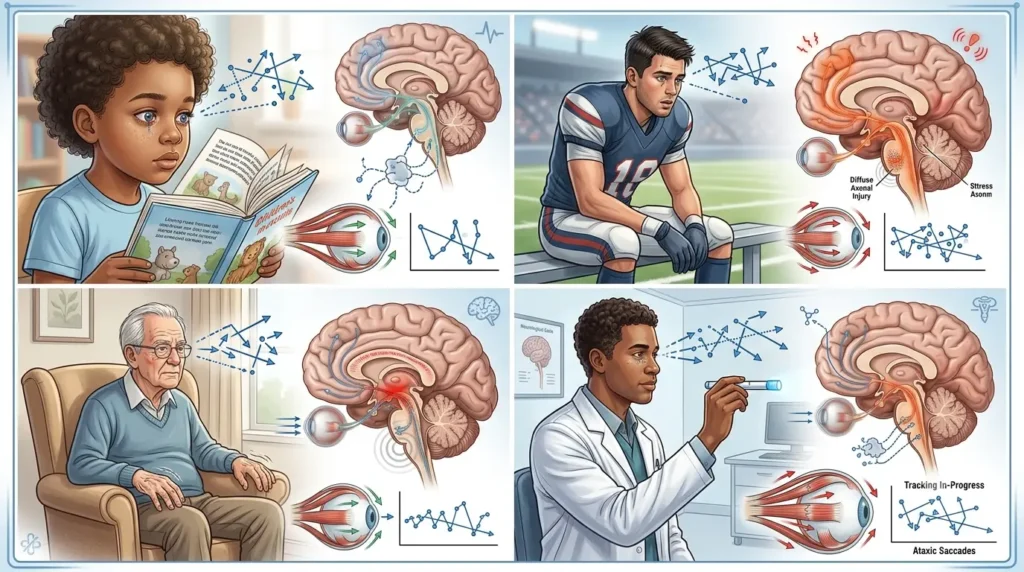
Kids can be born with this, or it shows up as their visual system develops. Adults often develop it after a concussion, an illness, or a neurological event. Either way, it’s real, and it’s fixable in most cases.
Eye Tracking Problems by the Numbers
The numbers here surprised me the first time I looked them up, so let me just lay them out.
Convergence insufficiency, one of the most common eye tracking-related conditions, shows up in roughly 2% to 13% of school-age children, with 5% being the figure most often cited in the research. Some school-screening studies push that number even higher. One study on children ages nine to fourteen found a prevalence of about two to eight percent in a school screening setting, and other researchers have reported that convergence insufficiency affects up to one in every eight children, or roughly 13% of all school-aged students — meaning several kids in an average classroom could be dealing with it right now, undiagnosed.
Concussion changes the math dramatically. Up to 90% of adults have been shown to have some form of oculomotor dysfunction after a traumatic brain injury. In adolescents specifically, one study found that 70% of participants had at least one oculomotor diagnosis after a concussion, with vergence disorders affecting 60% and accommodative disorders affecting 57%, and nearly half had more than one oculomotor diagnosis at the same time Other reviews put post-concussion smooth pursuit dysfunction as high as 43% to 60%, and saccadic dysfunction between roughly 22% and 30%
These numbers matter because they show this isn’t a fringe issue. It’s common, it’s underdiagnosed, and it’s frequently mistaken for something else entirely.
Eye Tracking Problems vs Dyslexia: Why People Mix Them Up
I get asked this constantly. Is this the same as dyslexia? No. But I understand why people confuse them.
| Condition | What’s Actually Wrong | What You’ll Notice | Often Confused With |
|---|---|---|---|
| Eye Tracking Problems | Eyes move inaccurately between targets | Losing place, skipping lines, finger-reading | Dyslexia, ADHD |
| Convergence Insufficiency | Eyes won’t turn inward together for close work | Eye strain, double vision up close | Eye coordination problems |
| Dyslexia | Language processing, not a vision issue | Trouble decoding words and sounds | Eye tracking problems |
| ADHD | Attention regulation | Distractibility, can’t sustain focus | Eye tracking problems (overlapping symptoms) |
Here’s the thing nobody tells you: these conditions can exist on their own, or they can stack on top of each other. A kid can have both dyslexia and eye tracking issues and reading difficulties at the same time. That’s exactly why guessing is dangerous. You need a real evaluation, not a label slapped on based on one symptom.
Convergence insufficiency vs eye tracking problems is another mix-up I see a lot. Convergence insufficiency is about the eyes turning inward together for near work. Eye tracking problems are about movement accuracy across the page. They can overlap. They’re not the same thing.
Symptoms of Eye Tracking Problems
I want to describe this in plain terms, because the clinical language misses the human experience.
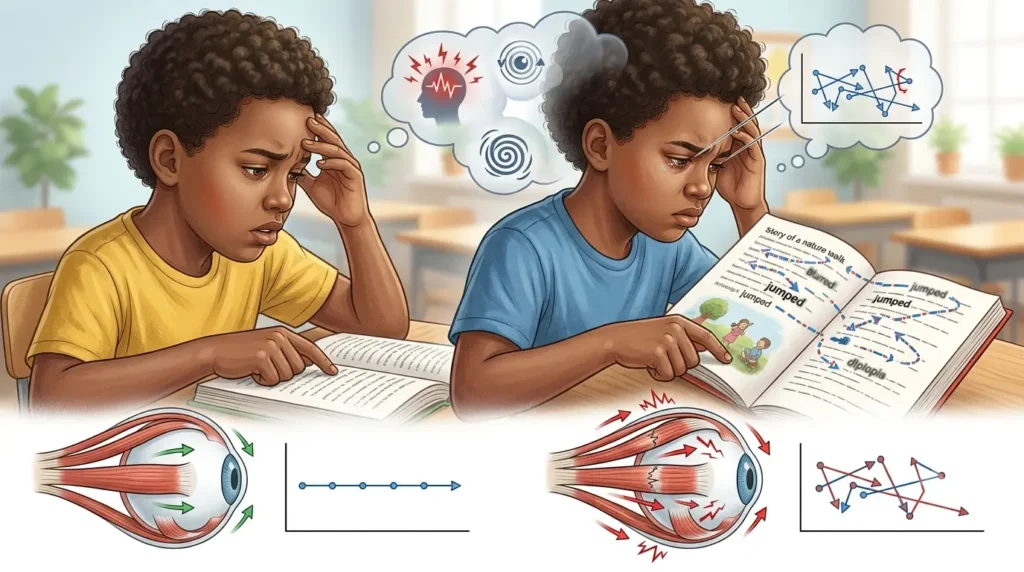
Reading doesn’t flow. You lose your spot constantly. You reread the same line, not because you weren’t paying attention, but because your eyes physically jumped to the wrong spot. Words seem to shift or blur for a second, even though your eyes are healthy. After a few minutes of focused reading, you’re mentally wiped out. Not bored. Wiped out.
For kids, this looks like refusing to read out loud. Frustration during homework that has nothing to do with the difficulty of the material. A strong preference for pictures over text, because text is genuinely more work for their eyes.
For adults, especially after a concussion, it often comes with dizziness, headaches, and visual fatigue during screen time or driving. Eye coordination problems and dizziness go hand in hand more often than people expect. If you’ve had a head injury and suddenly can’t read for long stretches without feeling off, that connection is worth taking seriously.
Short breaks, better lighting, and guided exercises help. But don’t expect overnight change. This improves gradually, not instantly.
Signs of Eye Tracking Problems in Kids (And Adults)
Here’s what to actually watch for. You don’t need every single sign on this list. Even two or three is worth investigating.
- Losing their place while reading, constantly
- Skipping lines or rereading the same ones
- A child uses finger to read — a vision problem sign, not just a habit
- Struggling to copy accurately from a whiteboard
- Mixing up similar-looking words
- Poor comprehension despite decoding words just fine
- Attention that tanks specifically during reading, not other tasks
- Headaches, dizziness, or eye strain after close work
- Clumsiness or shaky hand-eye coordination in some cases
If you’re asking “why does my child skip lines while reading,” this list is your starting checklist. It’s not a diagnosis. It’s a reason to get a real evaluation.
Is It Safe to Manage Eye Tracking Problems at Home?
Eye tracking problems aren’t dangerous on their own. But ignoring them chips away at academic confidence, comfort, and daily function. Let me lay out both sides honestly.
What gets better with early action:
- Reading fluency and comprehension often improve
- Visual fatigue and headaches during near work drop
- Kids gain confidence and classroom performance often follows
What you need to know before you get your hopes up:
- Eye tracking exercises for kids won’t magically fix every reading struggle
- Progress takes time. Consistency matters more than intensity
- Glasses don’t fix this. The problem is muscle coordination, not clarity
- Get evaluated by a real professional before starting any program on your own
This applies to both age groups, but young kids in early elementary school get evaluated most often. Reading demands spike hard in those grades, and that’s usually when the problem becomes obvious.
How to Fix Eye Tracking Problems: A Real Step-By-Step
A personalized program from a vision specialist is your best bet. Here’s the general path most programs follow.
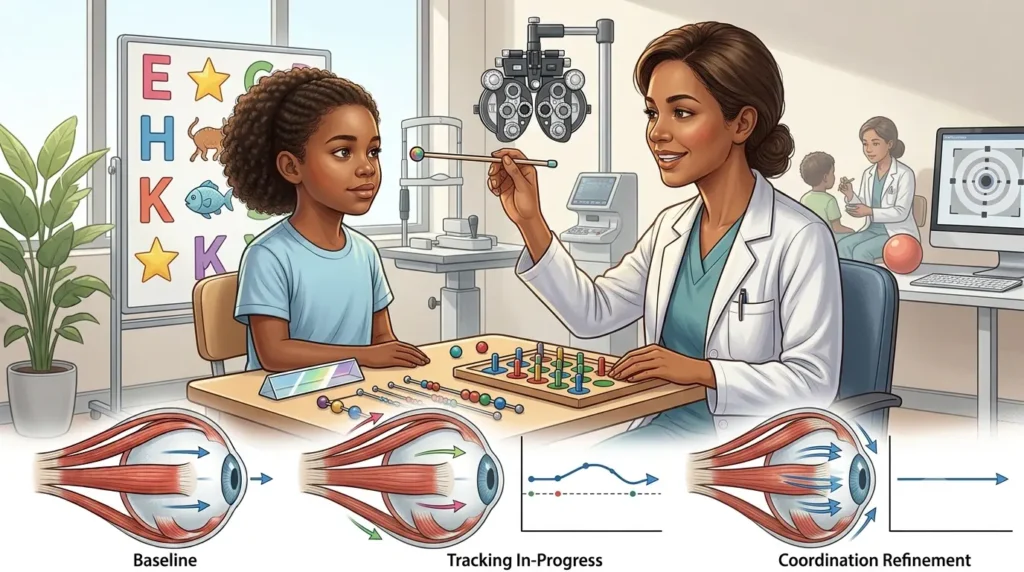
- Get a proper evaluation first. A functional vision assessment confirms whether tracking is actually your issue before you waste time guessing.
- Use guided tools the right way. A finger or index card helps early on. The goal is eventually reading without that crutch.
- Practice saccadic drills. Quick shifts between two fixed points — letter charts are the classic tool here.
- Add pursuit exercises. Move a pencil slowly side to side and follow it with your eyes only, not your head.
- Take breaks every 20 to 30 minutes during reading or screen time. This alone reduces strain fast.
- Show up consistently. Short daily sessions beat occasional long ones every time.
- Track progress with a professional. The program should shift as your skills improve.
Oculomotor Dysfunction Symptoms Worth Knowing
Oculomotor dysfunction symptoms overlap heavily with everything above: skipped lines, rereading, eye strain, headaches, and difficulty following moving objects smoothly. In adults, add dizziness and visual fatigue to that list, especially post-concussion. Poor eye tracking causes range from developmental delays in kids to brain injury, muscular imbalance, or convergence issues in adults. A comprehensive exam sorts out which one applies to you.
Common Mistakes When Managing Eye Tracking Problems
- Assuming glasses fix it. They ease some symptoms. They don’t retrain how your eyes move.
- Slapping on a learning disability label without testing. Some kids get called dyslexic or ADHD before anyone rules out a tracking issue.
- Quitting vision therapy too soon. Eye movement skills build slowly. Inconsistent effort just delays results.
- Brushing off symptoms after a concussion. Dizziness or reading trouble post-injury deserves real evaluation, not a “it’ll pass” shrug.
- Trusting school vision screenings alone. They’re useful, but they generally don’t test eye movement in any real depth.
How Eye Tracking Problems Are Actually Diagnosed
This is the part most articles skip over, and it’s the part that matters most. A real diagnosis isn’t one test. It’s a combination of several, and each one checks a different piece of how your eyes move and work together.
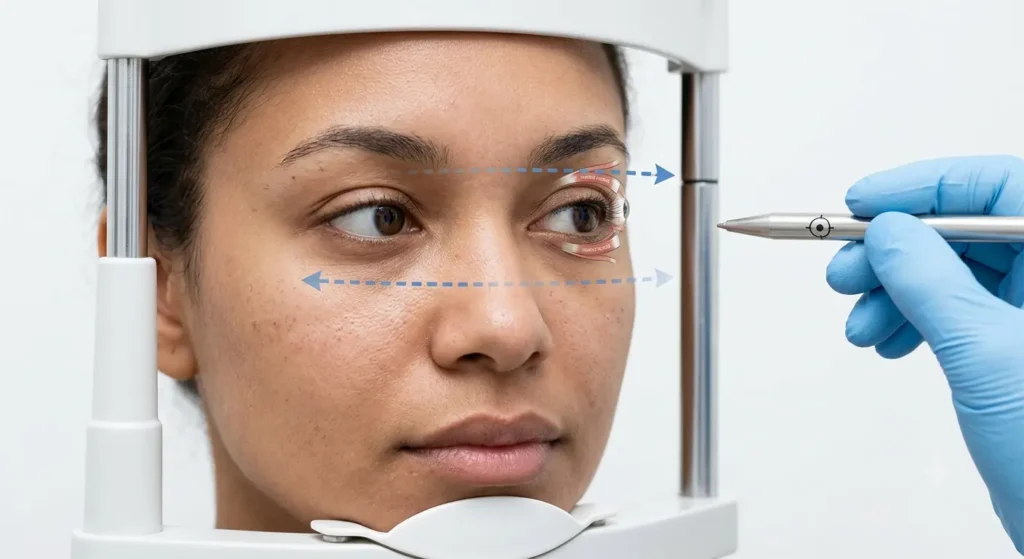
How to test eye tracking at home: Have someone slowly move a pen side to side, about a foot from their face. Watch their eyes follow it without moving their head. Jerky, delayed, or uneven movement is a red flag worth following up on. This is an informal check only. It’s not a substitute for a real exam, and it won’t catch subtler cases.
Here’s what a professional eye tracking problems eye exam actually involves.
Cover test. The examiner covers one eye at a time while you focus on a target, then watches how each eye moves when uncovered. This test checks for misalignment between the eyes, which can throw off tracking and depth perception even when each eye individually sees clearly.
Near Point of Convergence (NPC). You focus on a small target as it moves toward your nose. The examiner notes the exact point where one eye drifts outward instead of staying converged. A poor NPC score is one of the clearest signs of convergence insufficiency, and it’s one of the fastest tests to run in an exam.
Saccadic testing. You’re asked to jump your focus rapidly between two fixed targets, side to side or up and down, while the examiner watches for accuracy, overshooting, undershooting, or extra corrective movements. This directly measures the quick, jump-style eye movements used constantly during reading.
Smooth pursuit testing. You follow a slowly moving target with your eyes only, no head movement allowed. The examiner checks whether your eyes track it in one continuous motion or in small jerky steps. Jerky pursuit is a classic sign of oculomotor dysfunction.
DEM (Developmental Eye Movement) test. This is a standardized, number-based test where you read columns and rows of numbers as quickly as possible. It separates pure eye movement speed from language-processing speed, which makes it genuinely useful for telling eye tracking problems apart from something like dyslexia.
NSUCO test. This test scores saccades and pursuits on a numeric scale based on ability, accuracy, head movement, and body movement during the task. It’s widely used in developmental optometry because it gives a repeatable, objective score rather than a subjective impression.
None of these tests work well in isolation. A comprehensive oculomotor dysfunction test usually combines several of them, because a person can pass one and still fail another. That’s exactly how so many cases slip through a standard 20/20 screening untouched.
When Should You See an Eye Doctor?
- Ask specifically about a comprehensive exam that tests eye movement, not just the 20/20 chart
- Ask if they run NSUCO or DEM testing
- For kids, find someone who specializes in pediatric developmental vision — adult and child cases aren’t the same
- Ask for a realistic timeline. Weeks to months is normal. Days is not
- Walk away from anyone promising instant or guaranteed results
What Causes Poor Eye Tracking?
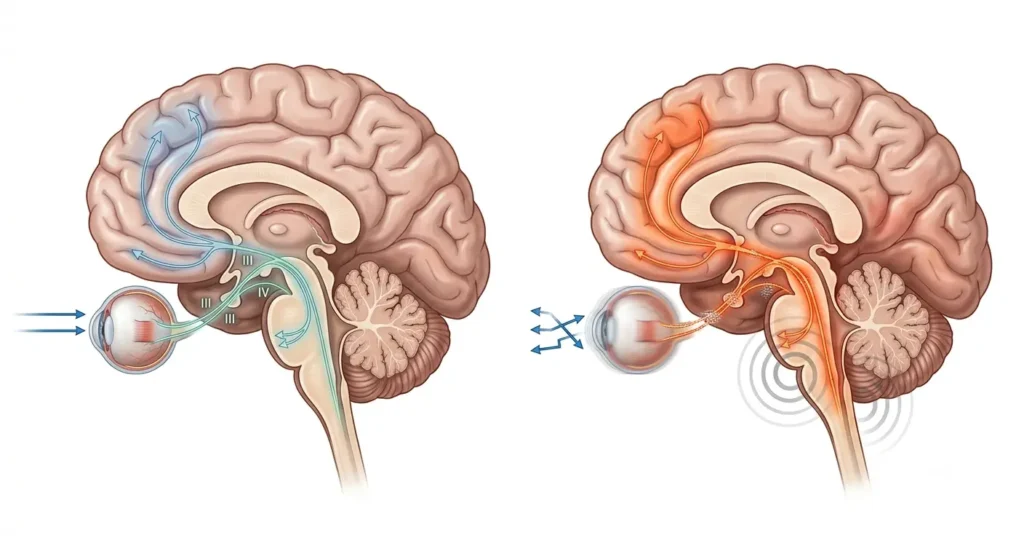
Poor eye tracking usually comes down to a coordination gap between eye muscles and the brain’s visual processing centers. It’s rarely about sharpness of vision. In kids, it’s often a developmental delay in visual-motor skills. In adults, the usual suspects are concussions, traumatic brain injury, neurological conditions, and sometimes years of uncorrected visual strain.
What Causes Eye Movement Problems in General?
Developmental delays, neurological events like stroke or concussion, muscular imbalance, and convergence insufficiency can all play a role. Saccadic eye movement problems and smooth pursuit dysfunction often show up together, which is why a full evaluation matters more than trying to self-diagnose from a symptom list.
Who Is Most at Risk for Eye Tracking Problems?
Some people are simply more likely to develop eye tracking problems than others. Here’s what pushes the risk up.
- Premature birth. Babies born early often have visual systems that haven’t finished developing, which raises the odds of tracking and coordination issues later.
- Developmental disorders. Conditions that affect motor planning or neurological development frequently come with eye movement difficulties attached.
- Stroke. Damage to the brain regions that control eye movement can disrupt saccades and pursuits immediately, and sometimes permanently without therapy.
- Parkinson’s disease. This condition is well known for slowing and disrupting saccadic eye movements, which is one reason reading and scanning get harder as it progresses.
- Multiple sclerosis. MS attacks the nerve pathways controlling eye coordination directly, and eye movement problems are one of its more common early signs.
- Concussion. As the numbers above show, this is one of the single biggest risk factors for adult-onset oculomotor dysfunction, and it’s also the most commonly missed.
If you fall into one of these categories and you’re noticing reading fatigue, dizziness, or visual discomfort, that’s not a coincidence you should ignore.
What Happens If You Leave It Untreated
I don’t want to scare anyone, but I also don’t want to sugarcoat this. Left alone, eye tracking problems tend to snowball.
- Academic problems. Kids fall behind in reading-heavy subjects, not because they’re not smart, but because the mechanical act of reading drains their energy before comprehension even starts.
- Reduced productivity. Adults burn through more time and mental energy just to get through basic reading or screen-based tasks.
- Reading avoidance. Both kids and adults start avoiding reading altogether. It’s not laziness. It’s an understandable reaction to something that feels exhausting every single time.
- Poor sports performance. Tracking a ball, an opponent, or a moving target relies on the same eye movement skills used in reading. Weak tracking shows up on the field, not just on the page.
None of this is permanent. But it does get harder to untangle the longer it goes unaddressed, especially once avoidance habits and confidence issues set in alongside the original problem.
Can You Prevent Eye Tracking Problems?
This part matters more than people think. You can’t prevent every cause, especially the neurological ones like stroke or MS. But you can catch problems early, and early action changes outcomes.
Get kids a real developmental vision check before problems show up, not after they’re already struggling in school. Limit excessive, uninterrupted screen time, since visual fatigue from screens can mask or worsen tracking symptoms. After any head injury, insist on a vision screening as part of concussion protocol, not as an afterthought. Address convergence and focusing issues early, since untreated near-vision problems can compound tracking difficulties over time. And don’t rely on a single vision screening at school as your only check — ask for a full functional exam if anything on the signs list rings a bell.
Prevention here isn’t about stopping the underlying cause. It’s about catching it before it costs a kid a year of confidence, or costs an adult months of unexplained fatigue.
Can You Fix Vision in 7 Days?
No, and I’d be lying if I told you otherwise. Eye coordination took months or years to develop the way it did. It’s not resetting in a week. Short-term steps — cutting screen strain, fixing your lighting, taking breaks, doing basic pursuit and saccadic drills daily — can bring modest relief within a week. Real, lasting improvement in tracking ability takes a structured program over weeks or months. Anyone promising a 7-day fix is selling you something.
Prognosis: Can Eye Tracking Problems Go Away?
Short answer: often, yes, especially with proper therapy. But the honest answer is more nuanced than that.
For kids with developmental tracking delays, the outlook is generally good. Their visual systems are still maturing, and structured vision therapy tends to produce steady, measurable gains over a matter of months. Most children who stick with a program see real improvement in reading fluency and comprehension.
For adults with concussion-related oculomotor dysfunction, the picture depends heavily on timing and severity. Some cases resolve within weeks as the brain heals. Others, especially with persistent post-concussion syndrome, take much longer and need dedicated vision rehabilitation rather than just rest. One research finding worth knowing: oculomotor deficits, particularly saccadic dysfunction, can persist even after other concussion symptoms like balance and coordination have normalized — which is exactly why “I feel fine now” doesn’t always mean your eye tracking has actually recovered.
For eye tracking problems tied to a progressive neurological condition, like Parkinson’s or MS, full resolution isn’t usually realistic. The goal shifts from “fixing it” to managing it and slowing the impact through targeted therapy and adaptive strategies.
So the fair answer is this: eye tracking problems can absolutely improve, and in many cases they resolve close to fully. Whether they go away completely depends on what caused them in the first place — which is, once again, why getting an actual diagnosis matters more than guessing.
Can Eye Tracking Problems Be Fixed?
Yes, for most people, with consistent effort. Vision therapy for eye tracking problems is the most reliable path. It’s a structured, professionally guided set of exercises. Glasses alone won’t do this job, because the issue is movement-based, not about lens correction. Expect gradual improvement, not an overnight switch.
Eye tracking exercises for adults follow the same core principles as pediatric therapy: saccadic drills, pursuit tracking, and consistency over weeks, adjusted for the specific cause behind the adult’s symptoms.
Eye Tracking Problems and ADHD
This one comes up a lot. Some research links irregular eye movement patterns to attention-related conditions. But eye tracking problems and ADHD are considered separate issues. They can show up together in the same person, which makes evaluation even more important. Don’t assume attention struggles automatically mean ADHD, and don’t assume reading struggles automatically mean a tracking issue. Get tested.
Frequently Asked Questions
What are the signs of eye tracking problems in kids? Skipping lines, using a finger to follow text, weak comprehension despite normal decoding skills, and frustration during reading-heavy homework.
Is eye tracking problems the same as dyslexia? No. Eye tracking problems are about how the eyes physically move. Dyslexia is a language-processing difficulty. They can overlap or get mistaken for each other, but they’re not the same condition.
How do I test eye tracking at home? Have someone follow a slow-moving pen side to side using only their eyes. Watch for jerky or delayed movement. This is a rough check, not a diagnosis.
Can adults develop eye tracking problems? Yes. Concussions, head injuries, and certain neurological conditions can trigger it in adults, often paired with dizziness and visual fatigue.
Are eye tracking problems linked to ADHD? Some research shows a connection between irregular eye movement and attention conditions. They’re still considered separate issues that can coexist.
Does vision therapy really work for eye tracking problems? Many people see real improvement in eye movement coordination over time. Results depend on the person, consistency, and how severe the underlying issue is.
Can eye tracking problems go away on their own? Sometimes, especially in mild developmental cases in kids or short-term concussion-related issues. But most cases need structured vision therapy to fully resolve, rather than improving on their own with time alone.
A Quick Honest Note
I’m writing this for general information. It’s not medical advice, and it’s not a replacement for a real optometric evaluation. If you or your child are dealing with reading struggles, eye strain, or anything on this list, go see a qualified eye care professional. Don’t self-diagnose off an article, including this one.
Where This Leaves You
Eye tracking problems are more common than most people assume. They hide behind labels like “lazy,” “unfocused,” or a misdiagnosed learning disability. The real issue was never how clearly someone sees. It’s how efficiently their eyes move while reading, scanning, or tracking something across a page or a room.
Catch the signs early. Get a real evaluation instead of guessing. Stick with a therapy program if one’s recommended. That combination makes a real difference for kids and adults both. Patience beats quick fixes here, every single time.